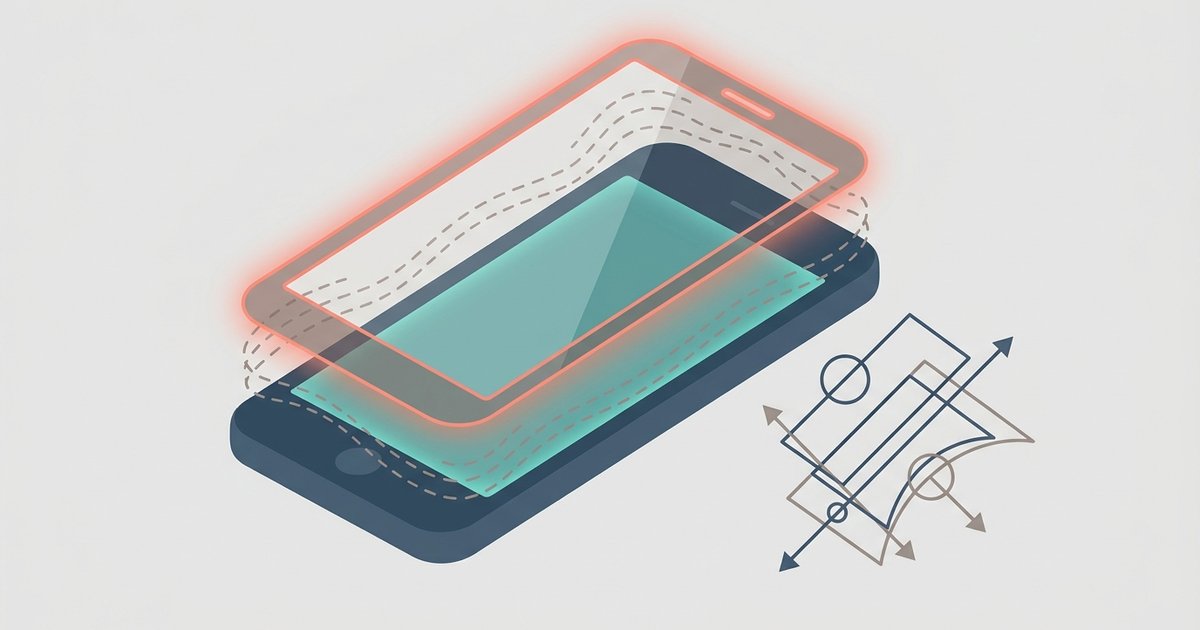
Screen size is just the diagonal measurement of the visible display, but a tempered glass protector must match the flat portion of the front glass, which is often narrower and shorter than the display on phones with curved edges.
The flat surface is smaller than the screen protector fit area
The mismatch you are seeing, halo bubbles, lifting edges, or overhang, is almost never about the diagonal measurement you used to measure smartphone screen size. It is about the physical geometry of the glass that sits above that display.
Most modern phones use "2.5D" glass, where the edges of the front panel curve gently downward before meeting the frame. If you place a ruler across the phone’s display, the visible diagonal might be 6.1 inches. The flat, bondable area, the part that a rigid tempered glass can actually adhere to, is often only about 5.7 to 5.9 inches across. When you press a protector onto this curved surface, the center adheres, but the edges hover in the air. This creates the classic "halo" effect and lifting along the perimeter. Many protectors are intentionally made slightly smaller than the display: they sacrifice coverage to stay within the flat zone. If you want to understand why manufacturers design screens this way, you should study how the curved glass is used to create one uninterrupted surface from display to metal frame. Even on a phone with a completely flat display, the protector must be cut to the exact flat dimensions, which are always less than the diagonal you measured.
Notch and punch-hole cutouts aren't universal
Two phones can share the exact same screen diagonal but have completely different notch shapes, camera hole positions, or sensor arrays. A protector designed for a generic "6.5-inch" screen will likely cover your proximity sensor or earpiece if your phone uses a teardrop notch while the protector expects a wide notch. Similarly, punch-hole cutouts for the front camera can be off by as little as 0.5 mm. This blocks the lens or creates a pressure point that lifts the glass. This is not a screen size problem; it is a cutout alignment problem. To see how these differences emerge across brands, read about the difference between smartphone and iPhone in terms of notch design and sensor placement. iPhone often uses a uniform notch array, while Android manufacturers vary cutout shapes even within the same model year. Always check the protector’s listing for a photo of the exact cutout pattern, not just the screen size.
Case compatibility shrinks the install window
Even a perfectly applied protector that lies flat on the display will fail the moment you snap on a case. Most cases have a slight lip that wraps over the edge of the phone’s front glass to hold the phone securely. If that lip overlaps the edge of the tempered glass, it exerts upward pressure, lifting the protector from the sides. This is especially common with protectors that are cut to the full width of the display rather than the flat bonding area. To avoid this, you must install the protector, then install the case, and check for lifting before the adhesive cures. If you are troubleshooting a phone, you can fix the issue by first removing the case, pressing down the edges of the protector, and then re-attaching the case to see if the lift returns. Many protectors now list "case-friendly" dimensions, which are typically 0.5-1 mm narrower than the glass edge. Ignoring this compatibility window is the most common reason a protector that fits the screen alone will not survive daily use with a bumper or folio case.
That issue, whether halo bubbles, lifting edges, or overhang, rarely stems from the diagonal you used to measure smartphone screen size but from the actual glass geometry above the display. Understanding this distinction is essential if you ever want to make a smartphone, as the same principles of fit and tolerance apply to every component that must align precisely within the device.