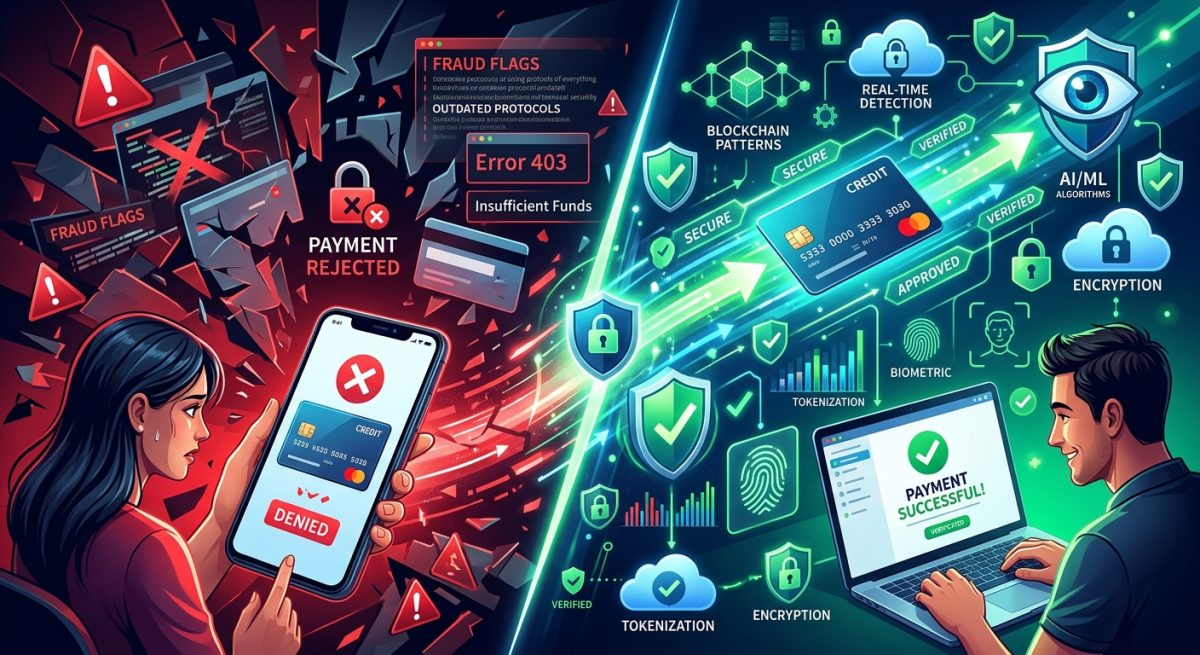
Your card is right there. The billing info is correct. The bank balance is fine. And still, the checkout page serves up a rejection with no real explanation. A failed payment is one of the most frustrating moments in online shopping, and the real cause is almost never what you think it is. In most cases, the problem is buried deep inside a chain of systems you have never heard of and cannot control.
What You Should Know
Online payments fail more often than they should, and the reason is almost never simple. A transaction passes through a payment gateway, a processor, a card network, and your bank before completing. Each layer has its own rules and failure conditions. New fintech tools are changing this by reading the context of each payment and picking the most reliable path before any of those failure points can stop the charge.
What Happens in the Two Seconds After You Click Pay
The moment you confirm a purchase, a chain of communication starts instantly. Your card details get encrypted and sent to a payment gateway. The gateway passes them to a payment processor. The processor contacts the relevant card network, whether that is Visa, Mastercard, American Express, or another. The card network then reaches your issuing bank, which checks the transaction against its internal rules and sends back an approval or a decline. That decision has to travel the entire chain in reverse before the merchant sees a result.
The whole process takes roughly two seconds. And in each of those handoffs, there is a potential point of failure that most shoppers never see coming. The system looks fast from the outside. Internally, it is a relay race with several different runners, none of whom are guaranteed to catch the baton cleanly.
What makes this harder is that each participant in that relay applies its own independent logic. Your bank has rules. The processor has rules. The card network has rules. Those rule sets do not always align, and when they conflict, the transaction falls apart silently.
The Failure Points Nobody Tells You About
Payment declines break down into a few broad categories, and knowing which one you are dealing with actually matters. Bank-side declines happen when your issuing bank decides, based on its own criteria, that it will not authorize the charge. Processor-side failures occur when the infrastructure between the merchant and the card network hits a technical snag. Network-level errors happen when data gets lost or routed incorrectly through the system. And fraud filter blocks kick in automatically when a scoring algorithm sees something that looks suspicious, even if the transaction is completely legitimate.
The specific reasons a bank might block a perfectly valid charge include:
- Velocity checks: your bank notices multiple purchases in a short window and pauses further activity as a precaution
- Billing address mismatches: the address you entered differs from what the bank has on file, even by a small formatting difference
- Card type restrictions: certain merchants only accept specific card types or networks, and your card simply does not qualify
- Processor downtime: the payment gateway or processor handling the transaction is temporarily offline or overloaded
- Cross-border friction: transactions that cross national boundaries trigger extra verification steps that some processors handle poorly
- Fraud score thresholds: the bank’s automated model labels the purchase as suspicious based on behavioral signals, with no human ever reviewing the decision
Why the Processor Layer Creates More Problems Than People Realize
A lot of failed payments never make it as far as your bank. They stall at the processor level, long before an authorization request is even sent. Payment processors have to speak the same technical language as both the merchant’s checkout system and the card network simultaneously. If those systems use slightly different data formats or communication protocols, the processor can reject the request outright. The merchant sees a failure. You see a decline. But no one actually asked your bank anything.
This problem is more common than most people assume. Subscription services, cross-border merchants, and businesses that accept many different payment methods are especially vulnerable. A payment made through a digital wallet often travels a different path than a standard card entry, and that alternate path may carry entirely different failure conditions. A gateway that handles one method reliably can stumble badly on another.
Merchants often spend weeks diagnosing these issues without finding a clear answer, because the error codes returned by processors are frequently generic. “Do not honor” or “system unavailable” tells the recipient almost nothing useful about what actually went wrong or how to prevent it from happening again.
How Real-Time Routing Picks a Better Path
Traditional payment setups work like a single-lane road. Every transaction travels the same fixed route regardless of what kind of card is being used, where it was issued, or whether that particular processor has been struggling with failures all afternoon. If that route is congested or broken, the payment fails. The merchant might ask you to try again, but retrying down the same broken path rarely helps.
Smarter systems take a fundamentally different approach. Before sending a transaction anywhere, they analyze the details in real time. They look at the card type, the issuing country, the currency, the merchant category, and the historical success rates for that combination of variables. Then they route the request to whichever processor and network path is statistically most likely to succeed at that moment, for that specific transaction.
This is precisely what smart payment routing does at its core. It acts as the decision layer that lives between the merchant’s checkout and the broader payment network. Instead of sending every charge down the same pipe, it reads the context of each payment and makes a routing decision in milliseconds. If one processor has been logging high failure rates for UK-issued Mastercards in the last thirty minutes, the system routes around it automatically, with no manual intervention required from either the merchant or the customer.
Traditional Routing vs. Intelligent Payment Routing
| Capability | Traditional Routing | Intelligent Routing |
|---|---|---|
| Path selection | Fixed, pre-configured route for all transactions | Dynamic path chosen per transaction based on real-time signals |
| Failure response | Transaction declines; customer must retry manually | System reroutes automatically before the decline reaches the shopper |
| Cross-border support | Often struggles with international card types and currencies | Routes based on issuing country and currency compatibility data |
| Success rate learning | No optimization; same path regardless of recent performance | Continuously adapts based on live approval and decline patterns |
| Failure diagnostics | Limited; generic error codes with little actionable detail | Granular reporting across processors, networks, and card types |
The Fraud Scoring Problem That Catches Legitimate Transactions
Even when the technical infrastructure works perfectly, a transaction can still get blocked by your bank’s fraud detection system. These systems score every authorization request against dozens of behavioral signals in real time. The device you are using, the IP address behind the connection, the time of day, the purchase amount, the merchant category, and the velocity of recent transactions all feed into a model that produces a risk score. If that score crosses a threshold, the bank declines the charge automatically. No human is involved.
U.S. banks operate under layered payment oversight requirements, which means every link in the payment chain carries its own independent security standards. Those standards were built to stop fraud. But because fraud scoring models are calibrated to flag statistically unusual behavior, a completely normal purchase can score just as high as a fraudulent one when the context looks unfamiliar. A gift bought from an overseas retailer late at night on a device you rarely use can hit all the wrong signals simultaneously, even if everything about the transaction is legitimate.
Banks rarely explain why a transaction was declined. The decline code sent back to the merchant is usually generic. The actual reason stays internal and is often never shared with the cardholder at all. This opacity is one of the biggest sources of checkout frustration, and it is something that smarter payment infrastructure can at least partially address by improving the quality and formatting of the data sent with each authorization request.
Retry Logic and the Hidden Power of Soft Declines
Not every decline is final. Payment professionals draw a clear line between hard declines and soft declines. A hard decline means the bank has rejected the transaction definitively, typically because the account is closed, the card is flagged for fraud, or the credit limit has been hit. Retrying a hard decline will not change the outcome. A soft decline is different. It means the bank could not process the request at that particular moment, but the underlying account is in good standing. The card is fine. The timing or circumstances were not.
Retrying a soft decline, sometimes with slight adjustments to the transaction data or by routing through a different processor, will often succeed. Older payment systems treat all declines the same way. They fail, surface an error message, and leave the retry decision entirely to the shopper. Smarter infrastructure reads the decline code, classifies it correctly, and in many cases retries the transaction behind the scenes. The customer never sees the failed attempt. The purchase completes on the second or third try without any manual action from the buyer.
This kind of intelligent retry logic is one of the cleaner examples of how modern payment infrastructure improves checkout outcomes without adding any visible complexity for the customer. The system absorbs the failure and corrects for it before the user ever knows something went wrong.
When Your Payment Reaches the Right Door the First Time
A payment that completes on the first try feels like a basic, unremarkable thing. You tap, you pay, you move on. But behind that moment is a stack of decisions made in milliseconds: which processor to use, which network path to take, how to format the authorization request, and how to respond if the initial attempt does not land cleanly.
The infrastructure making this work reliably has become genuinely sophisticated over the last decade. Card networks have improved their routing protocols. Banks have refined their fraud models to reduce the rate of false positives on legitimate purchases. Processors have added redundancy to minimize downtime. And intelligent routing tools have introduced a new decision layer that sits above all of them, optimizing each transaction before it enters the network at all.
For shoppers, this means fewer unexplained rejections and fewer moments of walking away from a purchase because the system failed them without saying why. The failure points in the payment chain are still real. But the tools to route around them are getting sharper, and the gap between a payment failing and a payment completing is closing fast. Most of the progress is invisible to the person at checkout. That invisibility is precisely the point.
\nRelated reading: What Travel Sites Use Afterpay and How To Get New Apps On Old Samsung Smart TV.