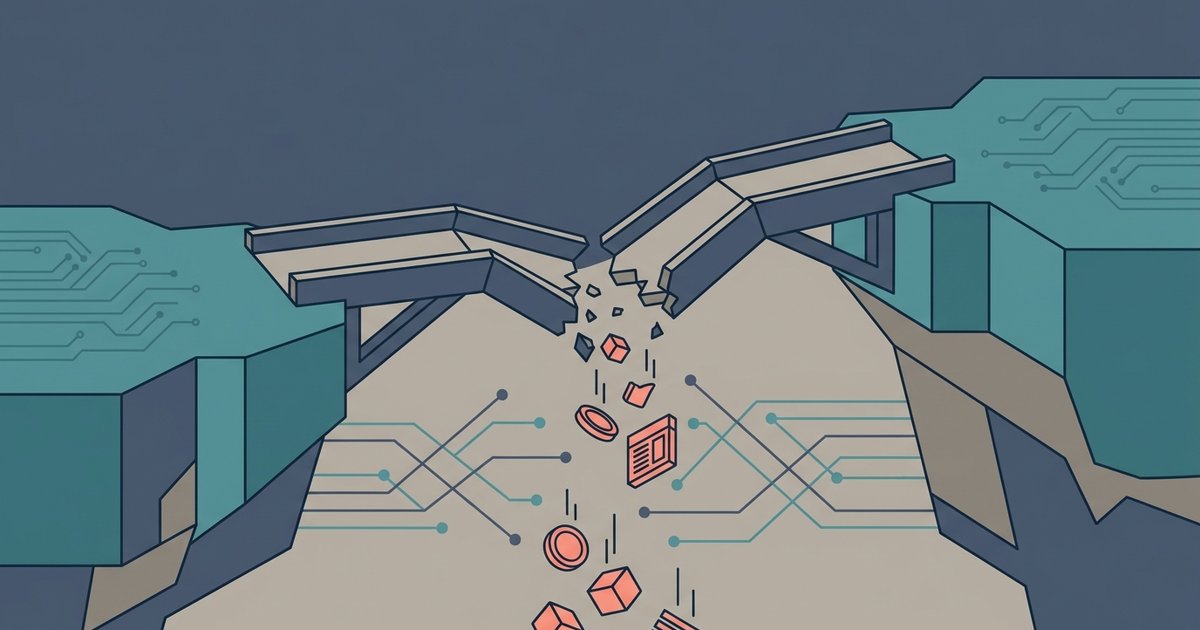
A blockchain bridge failure splits value into two irrecoverable halves: the synthetic assets on the destination chain lose their backing and become worthless, while the original assets remain permanently locked or stolen on the source chain. This is the core financial reality of a bridge exploit, the value does not simply disappear, it is fractured. One half is trapped in a smart contract that can no longer process withdrawals, and the other half is a derivative token that has lost its peg because the mechanism that once proved its existence has been destroyed. For any crypto holder considering depositing funds, understanding this two-sided loss is the difference between managing risk and losing everything.
The two-sided loss of a blockchain bridge failure
A bridge failure creates a precise mismatch. On the source chain, the original assets, say, 10,000 ETH deposited into the bridge’s smart contract, are frozen. If the bridge’s validator set or multi-sig is compromised, those ETH can be drained by an attacker; if the bridge suffers a smart contract bug that prevents any withdrawal, they are locked forever. Meanwhile, on the destination chain, the minted tokens (e.g., wETH) that represented those deposits still exist in wallets and liquidity pools. But without a functioning bridge to verify the backing, these bridged tokens become unbacked IOUs. Their price immediately depegs from the original asset, often crashing to near zero within hours as holders panic-sell. The loss is therefore twofold: the original chain loses real liquidity, and the destination chain gains a worthless ghost token.
When the bridged token outlives the bridge
A common misconception is that a bridged token retains independent value after its bridge dies. In reality, a bridged token is a claim check, not an independent asset. Its value derives solely from the bridge’s promise that it can be redeemed for the original asset. When the bridge fails, whether through a hack, a governance attack, or a software bug, that promise is void. The token continues to exist on the destination chain, but it is now an unbacked IOU that cannot be redeemed. Liquidity pools that still hold it become toxic; any trader who buys it after the failure is holding a digital receipt for a deposit that no longer exists. Before you choose a blockchain for a cross-chain deposit, book a direct audit of the bridge’s security history and current validator set, and arrive at your decision only after confirming the bridge has processed withdrawals successfully within the last 24 hours. Use the official bridge interface exclusively and skip any third-party front-end to avoid phishing clones.
Who eats the loss
The financial damage lands on specific parties, and there is rarely a bailout. Liquidity providers who supplied the bridged token to decentralized exchanges or lending pools are the first to absorb the loss, they see the token’s price collapse, and their positions become underwater. Last depositors are hit hardest: if you deposit ETH into a bridge hours before it fails, your original ETH is locked, and the wETH you receive on the other side is already worthless. Protocol treasuries sometimes step in with compensation, but this is not guaranteed. The Ronin bridge exploit in 2022 saw the project borrow funds to repay users, but most bridges lack such reserves. Understanding bridging in crypto means accepting that when a bridge fails, the loss is usually final, no DAO vote will restore your funds. The only protection is to avoid over-reliance on any single bridge, and to understand that sharding in blockchain, which splits a network into parallel chains, does not solve the trust problem of a centralized bridge; it only creates more points of failure. To protect yourself, split any cross-chain deposit across at least two independent bridges, and never deposit more than you can afford to see locked permanently.
Contagion beyond the bridge
The failure of a bridge does not stay contained. Because bridged assets are used as collateral in lending protocols, a depegging event triggers a cascade of liquidations. For example, if a user has deposited wETH on a platform like Aave to borrow USDC, and the wETH loses 90% of its value, their loan becomes undercollateralized instantly. The protocol liquidates the position, selling the wETH at a steep discount, which further drives down its price and liquidates more positions. Similarly, DEXs that list the bridged token see their pools drained as arbitrageurs exploit the price gap, and yield strategies that rely on the bridged asset for staking or farming become insolvent. The contagion can even spread to real-world systems: if you need to connect blockchain to bank account through a fiat on-ramp that accepts the bridged token, the on-ramp may freeze withdrawals or devalue your deposit. A single bridge failure can thus destabilize multiple protocols, trigger a wave of bad debt, and leave a chain of financial casualties that extends far beyond the original exploit. Before you bridge any asset, check whether the destination token serves as collateral in major lending markets to account for cascade risk.