What multi-modal perception systems actually are
Multi-modal perception systems fuse physically distinct sensing principles, such as optical cameras, LiDAR, microphones, inertial measurement units, and force transducers, into a single, unified environmental model that a robot can act upon in real time. The defining requirement is that each modality captures a fundamentally different physical quantity: photons, sound pressure waves, time-of-flight distance measurements, or mechanical forces. A common misconception is that two cameras covering the same view constitute multi-modal perception, but duplicated hardware of the same sensing type does not qualify, multimodal architectures require physically distinct sensing principles, not just multiple instances of the same sensor.
The single-sensor limitation that made fusion necessary
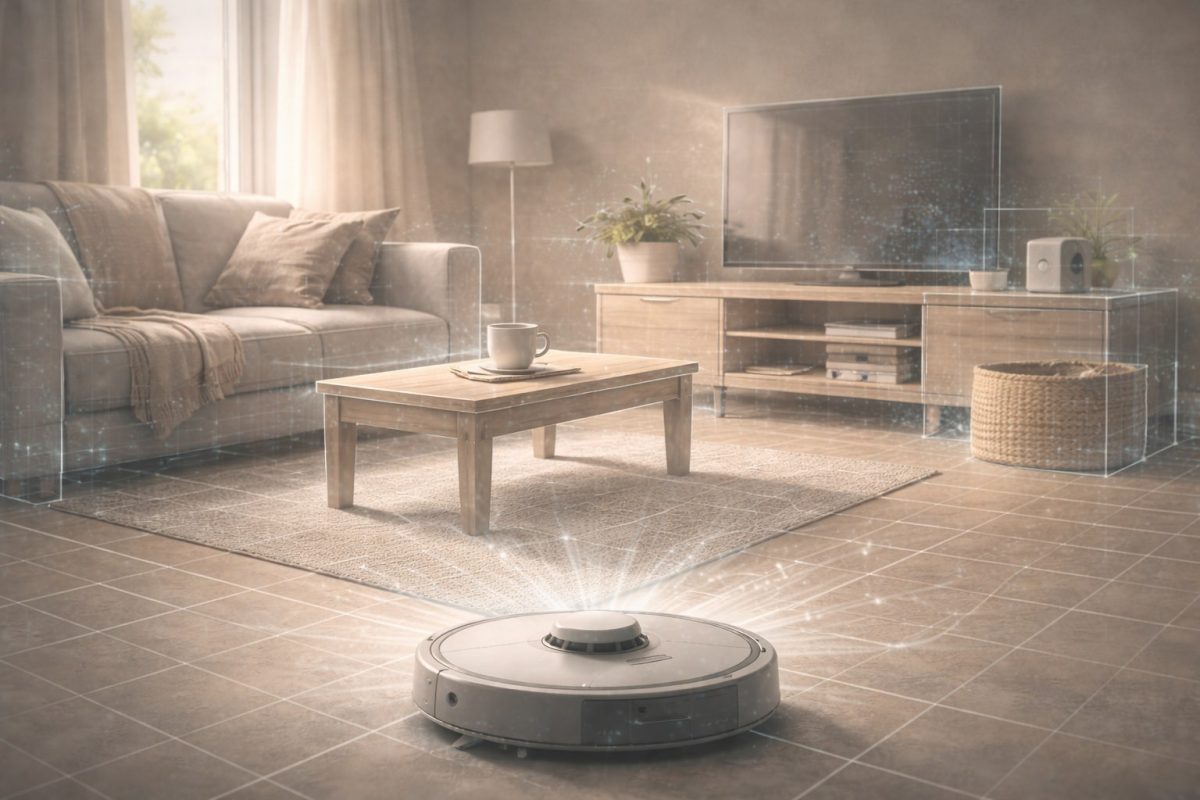
Early robots that relied on only one sensing principle failed in predictable, often catastrophic ways. First-generation autonomous vacuums used infrared proximity sensors and binary collision switches, which forced them into random-walk coverage algorithms, they bumped into furniture, missed entire rooms, and had no way to distinguish a wall from a charging dock. When manufacturers added monocular CMOS cameras, navigation improved in well-lit rooms but degraded sharply in low-illumination environments, and depth estimation beyond a few meters became unreliable. LiDAR solved the geometric mapping problem but returned only point coordinates, a cylindrical object was just [r, θ, φ] data, with no semantic information about whether it was a trashcan or a lamp. Each modality introduced inherent failure modes, and the core challenge became architectural: how to fuse heterogeneous data streams with different dimensionality, sample rates, and noise characteristics into a coherent world model for real-time decision making.
The five functional layers of a perception system
Every multi-modal perception system follows the same structural architecture, organized into five functional layers that process data from raw sensor readings to actionable output. The sensor acquisition layer captures raw measurements from all modalities simultaneously. The preprocessing and time-synchronization layer aligns timestamps across sensors, corrects for lens distortion, and normalizes data into consistent coordinate frames. The feature extraction layer converts raw signals into meaningful representations, edges and textures from images, geometric primitives from point clouds, phonemes from audio. The fusion layer combines these features through attention mechanisms or probabilistic methods to create a unified environmental model. Finally, the inference/output layer interprets the fused representation to produce decisions, such as obstacle avoidance commands or navigation waypoints. This layered framework makes it possible to swap individual sensors without redesigning the entire perception stack.
Early, mid-level, and late fusion strategies compared
Three architectural approaches dominate sensor fusion, differing in where the combination happens. Early fusion concatenates raw sensor data before any processing, preserving all information but creating high-dimensional inputs that are sensitive to sensor misalignment and noise. Mid-level fusion extracts features from each modality independently, then combines those features, this balances information preservation with robustness. Late fusion trains separate machine learning models for each sensor and combines their independent predictions, which is simple but has shown significant limitations because each model makes decisions without access to information from other modalities. The field is shifting toward training a single machine learning model on multiple sensor types simultaneously, allowing the network to learn cross-modal correlations during training rather than combining outputs ad hoc. This single-model approach consistently outperforms traditional late fusion in real-world robotics applications.
Camera and vision data in the perception stack
Cameras provide the richest semantic information in the perception stack through vision transformers that apply attention mechanisms to image patches. These architectures excel at texture classification and semantic segmentation, distinguishing carpet from hardwood, identifying floor surfaces, and recognizing object categories with high precision. Vision transformers achieve strong performance on obstacle classification through self-supervised pre-training on large annotated datasets, and they provide the visual context needed for tasks like identifying power cables or pet toys. However, cameras have a critical weakness: they fail completely in zero-lux environments due to the quantum efficiency limitations of CMOS sensors, and their precision drops significantly under variable illumination. A camera alone cannot provide reliable geometric information, making it an incomplete modality for navigation.
LiDAR and depth sensing for geometric understanding
LiDAR and time-of-flight sensors provide the precise spatial data that cameras lack, generating point clouds with millimeter-level accuracy at ranges up to several meters. These sensors are immune to lighting conditions, they work identically in bright sunlight and complete darkness, and they generate dense occupancy grids that enable systematic coverage planning through wavefront expansion algorithms rather than stochastic exploration. ToF sensors offer a cost-effective alternative with structured-light projection for shorter ranges. But LiDAR provides only geometric abstraction without semantic context: it returns coordinates for a cylindrical object but cannot distinguish between a trashcan and a lamp without modality fusion. The geometric precision of LiDAR must be paired with the semantic richness of cameras to produce a complete environmental understanding.
Language understanding grounds commands in physical space
Natural language processing has become a standard component in modern robotic systems, with BERT-derived transformers converting spoken or typed commands into structured action primitives aligned with the robot's topological map. Command parsing uses attention mechanisms over tokenized inputs to extract spatial references and action intents, "clean around the dining table" becomes a set of geometric waypoints and coverage constraints. The fundamental challenge is symbol grounding: mapping linguistic abstractions to physical percepts requires cross-modal attention between language embeddings and spatial maps. Current architectures handle room-level commands effectively but struggle with complex spatial relationships that require full 3D scene understanding. Language provides the high-level intent, but it must be anchored to concrete sensor data to be actionable.
Why audio is not a peripheral modality
A common misconception is that audio is a peripheral modality, secondary to vision and depth sensing. Acoustic data provides critical signals that optical or depth sensors cannot detect: a smoke alarm, breaking glass, a baby crying, or a dog barking are all events that produce no visual or geometric signature but carry urgent information. A robot that hears a smoke alarm can respond appropriately even if the alarm is outside its camera's field of view or in a dark room. Audio also provides spatial cues through inter-aural time differences, enabling sound source localization that complements visual tracking. Treating audio as optional severely limits a robot's situational awareness, it is a primary modality for detecting events that are invisible to every other sensor type.
Proprioceptive and force sensing for internal state
Environmental perception alone is insufficient for robust control; robots also need self-awareness of their own motion, pose, and physical interactions. Nine-axis IMUs combining accelerometers, gyroscopes, and magnetometers track rigid body dynamics at high frequency, enabling pose estimation through complementary filtering with minimal drift. Quadrature encoders on drive wheels provide odometry data for dead reckoning. Force transducers measure normal and tangential contact forces, triggering immediate trajectory replanning when collisions occur through reactive control loops. This proprioceptive feedback enables closed-loop PID control and helps distinguish between commanded motion and external perturbations through discrepancy analysis between expected and measured state transitions. Without these internal-state sensors, a robot cannot know whether it is moving as intended or being pushed off course.
How cross-modal attention fuses it all together
Transformer-based fusion networks with cross-modal attention mechanisms represent the architectural breakthrough that makes multi-modal perception practical. These systems implement heterogeneous feature extractors for each modality, then apply cross-attention layers where features from one modality query features from another, RGB-detected obstacles trigger focused LiDAR attention for precise distance measurement through adaptive point cloud sampling. The attention mechanism dynamically weights sensor importance based on environmental conditions: in low-illumination scenarios, the fusion network assigns higher attention weights to LiDAR features, while for obstacle classification it prioritizes RGB features. State-of-the-art approaches employ hierarchical fusion at multiple temporal and spatial scales, with coarse LiDAR data handling global localization and fine-grained RGB data managing object detection. Feature pyramid networks enable multi-resolution reasoning across sensor modalities, and cross-modal conditioning allows language embeddings to guide attention across spatial representations.
Real-world performance gains from multi-modal fusion
Deployed systems demonstrate quantified improvements from multi-modal fusion over unimodal approaches. Localization error reduces by 47%, with root mean square error dropping from 8.3 centimeters to 4.4 centimeters when camera, LiDAR, IMU, and wheel encoder data are fused through visual-inertial SLAM with factor graph optimization. Obstacle detection precision improves from 73% to 92% through ensemble fusion of RGB, depth, and motion features. Coverage efficiency increases by 22% through systematic trajectory planning enabled by dense occupancy grids, rather than random exploration. Safety improves through redundant perception channels that mitigate single-sensor failure modes, if one modality degrades, others compensate. These gains translate directly to consumer robotics: home security robots implement lightweight SLAM variants optimized for embedded processors, and premium vacuum platforms construct persistent multi-floor environment representations with automated room segmentation.
The path forward for perception systems
The next generation of perception systems will be built on foundation models trained on multi-modal datasets exceeding ten terabytes, enabling zero-shot generalization across environments through contrastive learning between modalities. These systems will leverage collective experience from millions of homes to adapt to novel environments through meta-learning techniques requiring minimal domain-specific fine-tuning. Edge computing remains the critical enabler: processing multi-modal data requires significant compute, yet privacy considerations and sub-100-millisecond latency requirements necessitate on-device inference. Neural architecture search and mixed-precision quantization are making transformer-based fusion viable on embedded SoCs with dedicated neural processing units, and sparse attention mechanisms reduce quadratic complexity to linear, enabling real-time performance on consumer hardware. The robotics platforms entering homes over the next five years won't just navigate, they'll understand spatial semantics, object affordances, and implicit human preferences, fundamentally transforming the human-robot interaction paradigm.
\nRelated reading: Who Is Sophia the Robot: Everything You Need to Know About Her and What Is SOTA In Machine Learning.