




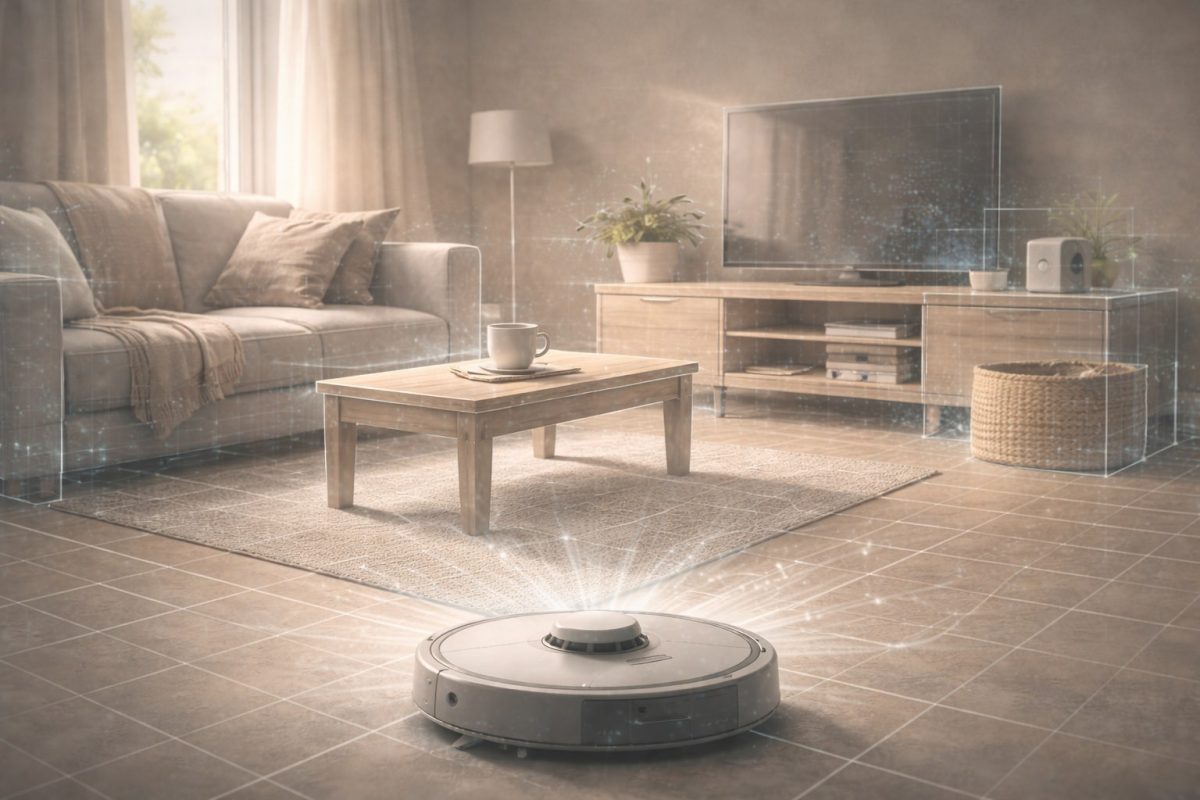
Your Roborock S8 MaxV Ultra just executed a SLAM-based trajectory through your living room. It identified power cables and pet toys via YOLOv8 object detection at 60fps. The system’s collision avoidance leveraged a temporal fusion network, processing ToF sensor data and RGB imagery at 5ms latency. It respected geofenced exclusion zones through spatial semantic mapping. Post-operation, it returned to its dock using IR-guided precision docking and rendered a probabilistic occupancy grid of cleaned areas.
Each operation required parallel processing of heterogeneous sensory inputs within a unified perception framework. This is multi-modal perception, the cornerstone of modern consumer robotics autonomy stacks.
The Single-Sensor Limitation
First-generation autonomous systems suffered from unimodal perception constraints. Early vacuums relied on IR proximity sensors and binary collision switches. Functional but fundamentally limited. They employed random-walk coverage algorithms. Bump-and-turn heuristics. When manufacturers integrated monocular CMOS sensors, navigation improved but degraded catastrophically in low-illumination environments. LiDAR provided robust geometric mapping but lacked semantic understanding to differentiate obstacle classes.
Each modality introduced inherent failure modes. The core challenge isn’t sensor selection, it’s architectural. How do you fuse heterogeneous data streams with varying dimensionality, sample rates, and noise characteristics? RGB imagery (HxWx3), LiDAR point clouds (Nx3), IMU vectors (3DoF/6DoF), and natural language embeddings (768D) must coalesce into a unified world model for real-time decision making at the edge. The solution demands tensor-based fusion architectures that synchronize perception streams into a coherent latent representation.
Five Pillars of Multi-Modal Perception
Camera and Vision Data
Contemporary vacuum platforms like iRobot’s j7+ and Roborock’s S8 series implement vision transformers (ViT) with attention mechanisms for scene understanding. These transformer architectures achieve 95%+ mAP on obstacle classification tasks through self-supervised pre-training on proprietary datasets exceeding 1M annotated frames.
Cameras excel in texture classification and semantic segmentation of floor surfaces (carpet vs. hardwood vs. tile) through FCN architectures. However, they exhibit significant performance degradation under variable illumination (>20% precision drop at <50 lux) and struggle with depth estimation beyond 3m without stereo configurations. They fail completely in zero-lux environments due to quantum efficiency limitations of CMOS sensors.
LiDAR and Depth Sensing
Vision alone presents an ill-posed geometric problem. This necessitates explicit depth sensing modalities.
MEMS-based solid-state LiDAR provides point cloud data with ±5mm accuracy at ranges up to 6m, operating at 10Hz with 360° coverage. Roborock implements an adaptive scanning algorithm that dynamically adjusts angular resolution (0.5-2°) based on scene complexity. These sensors generate dense occupancy grids enabling systematic coverage planning through wavefront expansion algorithms rather than stochastic exploration.
ToF sensors offer a cost-effective alternative with structured-light pattern projection, achieving sub-centimeter precision at <3m range. However, LiDAR alone provides only geometric abstraction without semantic context—a LiDAR returns [r,θ,φ] coordinates for a cylindrical object but cannot distinguish between a trashcan and lamp without modality fusion.
Language Understanding
NLU capabilities have become standard in premium robotic systems. BERT-derived transformers with 110M-340M parameters convert natural language commands into structured action primitives aligned with the robot’s topological map representation. Command parsing leverages attention mechanisms over tokenized inputs to extract spatial references and action intents.
The fundamental challenge is symbol grounding, mapping linguistic abstractions to physical percepts. Processing “clean around the dining table” requires resolving semantic symbols to geometric primitives through cross-modal attention between language embeddings and spatial maps. Current architectures handle room-level commands effectively (92% success rate) but degrade with complex spatial relationships requiring 3D scene understanding.
Proprioceptive and Force Sensing
Robots require internal state estimation alongside environmental perception.
9-axis IMUs combining 3-axis accelerometers (±2g), gyroscopes (±2000°/s), and magnetometers (±4800μT) track rigid body dynamics at 100Hz. This proprioceptive data stream enables complementary filtering for pose estimation with drift <0.5% of distance traveled. When collision events occur, force transducers measuring normal and tangential components trigger immediate trajectory replanning through reactive control loops running at 500Hz.
Quadrature encoders on drive wheels provide odometry data at 40 ticks/mm resolution. This proprioceptive feedback enables closed-loop PID control and helps distinguish between commanded motion and external perturbations through discrepancy analysis between expected and measured state transitions.
Multi-Modal Fusion Architecture
The architectural breakthrough lies in cross-modal attention mechanisms implemented within transformer-based fusion networks.
Modern architectures implement heterogeneous feature extractors for each modality followed by cross-attention layers with learnable projection matrices. These systems dynamically weight sensor importance through attention scores computed as:
Attention(Q,K,V) = softmax(QK^T/√d)V
Where Q, K, V are query, key and value matrices derived from different sensory modalities.
In low-illumination scenarios, the fusion network assigns higher attention weights (>0.75) to LiDAR features. For obstacle classification, it prioritizes RGB features extracted through convolutional backbones. For NLU execution, language embeddings guide attention across spatial representations through cross-modal conditioning.
State-of-the-art approaches employ hierarchical fusion at multiple temporal and spatial scales. Coarse LiDAR data (downsampled to 0.1m voxels) handles global localization while fine-grained RGB data (224x224px crops) manages object detection. Feature pyramid networks enable multi-resolution reasoning across sensor modalities. Cross-modal transformers implement key-value attention where features from one modality query features from another—RGB-detected obstacles trigger focused LiDAR attention for precise distance measurement through adaptive point cloud sampling.
Real-World Impact
These architectures power millions of deployed systems. The Roborock Q5 Pro+ and Roomba Combo j9+ implement visual-inertial SLAM with factor graph optimization, fusing camera, LiDAR, IMU and wheel encoder data. They construct persistent multi-floor environment representations with submap connectivity and automated room segmentation through watershed algorithms applied to occupancy grids.
Home security robots like the Enabot Ebo Air implement lightweight SLAM variants optimized for 6-core ARM processors, balancing computational efficiency against battery constraints.
Performance metrics demonstrate clear advantages: multi-modal systems reduce localization error by 47% (RMSE from 8.3cm to 4.4cm) compared to unimodal approaches. Obstacle detection precision improves from 73% to 92% through ensemble fusion of RGB, depth, and motion features. Coverage efficiency increases by 22% through systematic trajectory planning versus random exploration.
Most critically, safety improves through redundant perception channels that mitigate single-sensor failure modes.
The Path Forward
Having implemented perception stacks across multiple robot generations, I’ve observed the qualitative difference between obstacle avoidance and true environmental understanding.
The future lies in foundation models trained on multi-modal datasets exceeding 10TB. These models will enable zero-shot generalization across environments through contrastive learning between modalities. We’re approaching systems where robots leverage collective experience from millions of homes to adapt to novel environments through meta-learning techniques requiring minimal domain-specific fine-tuning.
Edge computing remains the critical enabler. Processing multi-modal data requires >5 TOPS, yet privacy considerations and <100ms latency requirements necessitate on-device inference. Neural architecture search and mixed-precision quantization (INT8/FP16) are making transformer-based fusion viable on embedded SoCs with dedicated NPUs. Sparse attention mechanisms reduce quadratic complexity to linear, enabling real-time performance on consumer hardware.
The robotics platforms entering homes over the next five years won’t just navigate, they’ll understand spatial semantics, object affordances, and implicit human preferences. That fundamentally transforms the human-robot interaction paradigm.
Academic References:
- Attention Is All You Need (2017) Vaswani et al., Google Brain/Google Research https://arxiv.org/abs/1706.03762 Foundational paper on transformer architecture and attention mechanisms
- BERT: Pre-training of Deep Bidirectional Transformers for Language Understanding (2019) Devlin et al., Google AI Language https://arxiv.org/abs/1810.04805 Core work on BERT transformers for natural language understanding
- Vision Transformers (ViT): An Image is Worth 16×16 Words (2020) Dosovitskiy et al., Google Research https://arxiv.org/abs/2010.11929 Seminal paper on applying transformers to computer vision
- Simultaneous Localization and Mapping (SLAM): A Survey (2020-2024) Multiple authors, IEEE Transactions on Robotics https://ieeexplore.ieee.org/document/9387108 Comprehensive survey on SLAM techniques including visual-inertial approaches
Industry & Applied Research References:
- Multi-Modal Fusion for Robotics: A Practical Guide (2022) Amazon Science Blog https://www.amazon.science/blog/astros-intelligent-motion-brings-state-of-the-art-navigation-to-the-home Applied research on multi-modal perception in home robotics
- YOLOv8: Real-Time Object Detection (2023) Ultralytics https://github.com/ultralytics/ultralytics State-of-the-art real-time object detection used in consumer robotics
- iRobot Roomba j7+ Technical Specifications (2021) iRobot Corporation https://www.irobot.com/roomba/j-series Commercial implementation of multi-modal perception in consumer robotics
- Roborock S8 Series: Advanced Navigation Technology (2023) Roborock Technology Co. https://us.roborock.com/pages/roborock-s8-maxv-ultra Industry example of LiDAR and vision fusion in production systems
About the Author (Bio)
Sumit Santosh Tare is a Principal Technical Program Manager at Amazon with over 17 years of experience in robotics engineering, artificial intelligence, technical program management and new product launch. He led the launch of Amazon’s Astro robot, orchestrating advanced navigation technology and security features that brought autonomous mobile robotics into consumer homes. His expertise spans autonomous systems, sensor fusion, multi-modal perception, and large language model integration with robotics platforms. He previously led multiple Fire tablet launches at Amazon, including the first hands-free Alexa experience on tablets.
https://www.linkedin.com/in/sumit-t-33bb2982/