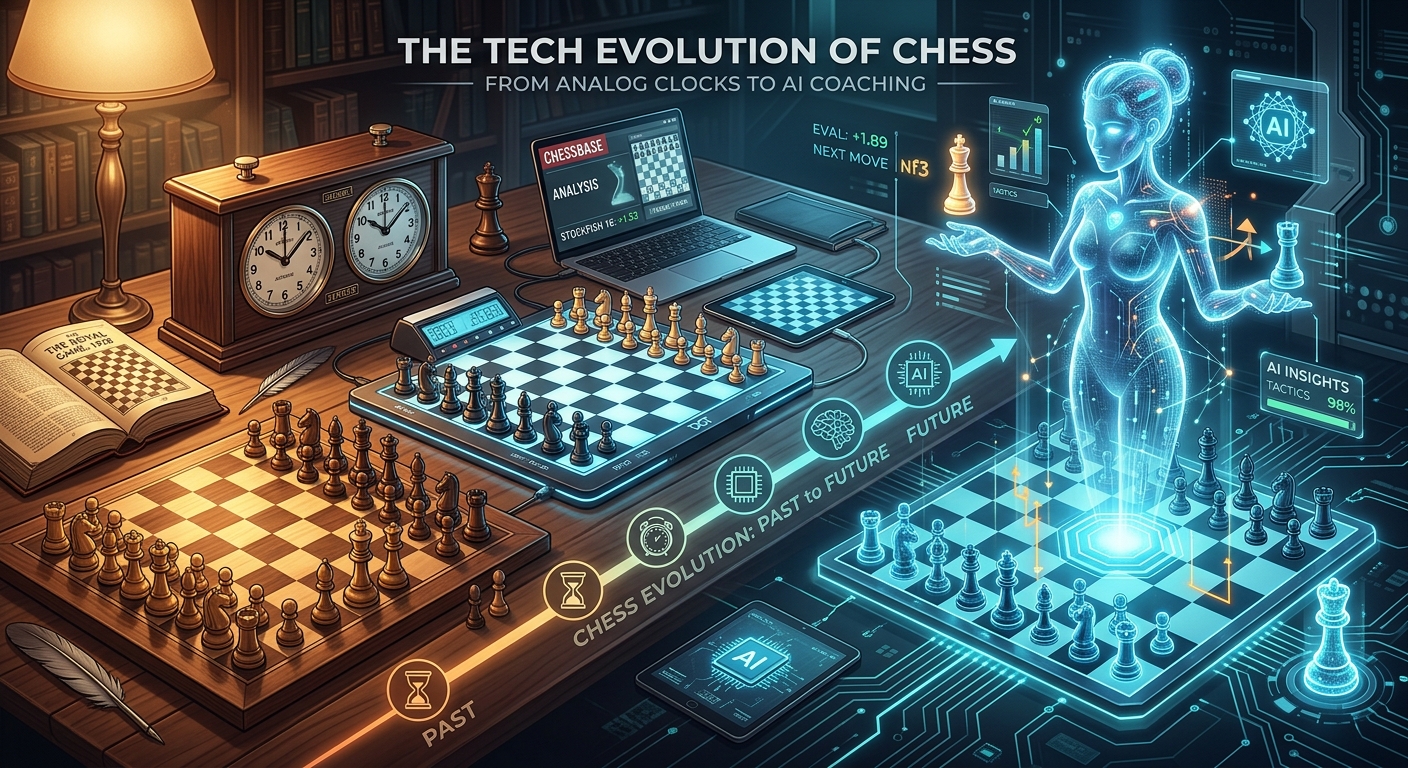
Chess has been played for roughly 1,500 years. For almost all of that time, nothing about it involved electricity. You needed pieces, a board, and an opponent. That was the whole setup. Then, over the past century and a half, a quiet technological creep began. A mechanical clock appeared. Then a digital one. Then a computerized opponent that could crush any grandmaster alive. Today, a free app on your phone can break down every mistake you made in your last game with the precision of a world-class coach. The transformation of chess from analog pastime to tech-integrated hobby is one of the more underappreciated stories in consumer technology.
Chess Tech at a Glance
- Chess timing hardware evolved from mechanical double-clocks to precise digital devices that now manage complex time controls used in competitions worldwide.
- Digital boards and wireless hardware turned over-the-board play into real-time global broadcasts, connecting physical games to online platforms for millions of viewers.
- AI coaching apps have placed grandmaster-level analysis inside the pocket of any player with a smartphone, at no cost.
When Chess Had No Deadline
Early chess matches had no time limits at all. Players could sit and think for hours between moves. There are accounts of 19th-century games where a single decision consumed the better part of an afternoon. The 1851 London international tournament, widely considered the first major chess competition of its kind, made the problem impossible to ignore. Spectators grew restless. Organizers had no way to manage schedules. A game between two deeply methodical opponents could grind on indefinitely.
The earliest fix was a sandglass. Each player had one, flipped at the start of their turn. Simple enough in theory, but impractical for any serious competitive format. The real leap came with the double-clock mechanism, which linked two separate timekeepers on a single device. Pressing your button stopped your clock and started your opponent's. This invention, developed in the latter half of the 1800s, gave competitive chess a practical backbone it had never had before. For anyone who wants the full picture of that hardware development, the deep-dive into chess clock history covers everything from those first mechanical prototypes through to the precise digital models used in modern tournaments.
Mechanical Clocks and the Making of Competitive Standards
Once double-clocks became the norm, chess organizations could enforce time controls with genuine teeth. Players were now assigned a set number of moves to complete within a fixed time period. If your flag dropped before you finished, you lost the game regardless of the position on the board. This single rule change made chess viable as a spectator sport and opened the door to professional competition.
The physical mechanism of those clocks was entirely analog. Spring-loaded gears, a pendulum-style escapement, and a small flag mounted on the clock face that fell when the spring wound down. Tournament directors trusted them for decades because they were robust and required no batteries. But they had meaningful limits. They could handle only one simple time format per game. Complex structures with incremental time additions per move were impossible to implement with mechanical parts.
Standardizing time controls became a priority for the international governing body of chess as the sport grew. Today those rules cover everything from classical games lasting several hours to rapid formats and blitz games measured in minutes, and they are formalized through official competition rules that apply at every level of the game worldwide.
Digital Clocks and the Fischer Increment
The shift to digital clocks was not just a cosmetic upgrade. It opened up entirely new ways to manage game time. The most significant of these was the increment, a small number of seconds added to a player's remaining time after each move they complete. This idea is closely associated with Bobby Fischer, who proposed it in the 1980s as a solution to a genuine problem: endgames where both players were blundering badly just to avoid losing on the clock rather than on the board.
With a digital clock, programming a five-second bonus per move became trivially straightforward. The Bronstein delay, a related method where the clock simply pauses briefly at the start of each turn before counting down, offered a similar fix through a slightly different mechanism. Both formats required programmable logic and digital displays that no mechanical clock could ever provide. Models like the DGT 2010 and later the DGT 3000 became staples of serious tournament play throughout the 1990s and 2000s. They were accurate, programmable, and durable enough to survive the punishing travel schedules of elite players. The analog clock did not disappear entirely, but its role in competitive chess shrank dramatically over those two decades.
How Boards Got Smart
The digitization of chess hardware did not stop at clocks. Electronic boards capable of detecting piece positions began appearing at major events during the 1990s. These boards use sensors embedded beneath each square to identify which pieces are present. Game moves are captured automatically and transmitted to computers for recording and broadcast in real time.
DGT, short for Digital Game Technology, became the dominant name in this space. Their boards gave online viewers the ability to follow top-level games move by move as they happened, displayed on a screen with perfect accuracy. For the first time, someone watching from home could track a world championship game with the same fidelity as a journalist sitting in the press room. Commentary streams attracted hundreds of thousands of viewers. Platforms including Twitch and YouTube turned grandmaster games into live entertainment that could compete with other forms of digital media for attention. The smart board was a quiet enabler of almost all of it.
AI Steps Onto the Board
The story of artificial intelligence in chess is one of the more famous chapters in the broader history of computing. IBM's Deep Blue defeated world champion Garry Kasparov in 1997 in a match that made international headlines. That result planted a question in many people's minds: if a machine could beat the best human player alive, what could it teach ordinary players who wanted to improve?
For a long time, the practical answer was "not much." Running a top chess engine required expensive hardware and a degree of technical knowledge most hobbyists did not have. The engines existed and were genuinely powerful, but they were not user-friendly tools for skill development. That changed gradually as processing power became cheaper and mobile hardware caught up with what desktop computers could do a decade earlier.
Today's strongest engines, including Stockfish and the neural-network-based Leela Chess Zero, can be integrated into apps that anyone can install at no cost. These engines evaluate positions at depths far beyond what any human can process consciously, but the apps built around them have done the work of translating that raw analysis into language a non-expert can actually use.
Coaching Apps and the Smartphone Era
Platforms like Chess.com and Lichess have built complete coaching ecosystems around engine analysis. After finishing a game, you press a button and receive a breakdown of every significant mistake, missed tactic, and stronger move available at each point in the game. The interface is visual and plain enough for a beginner to follow without a technical background.
A decade ago, getting that level of feedback meant either paying for lessons with a strong player or learning to navigate analysis software that came with a steep learning curve. Now it is a standard feature of free apps used by tens of millions of people across every skill level. Some notable capabilities that current apps bring to the table include:
- Move-by-move engine analysis with accuracy scoring after each completed game
- Personalized puzzle sets drawn from patterns identified in your recent losses
- Opening databases with performance statistics tied to your own game history
- Live broadcast integration for following professional events in real time
- Rating systems calibrated to millions of active users for fair matchmaking
The adaptive nature of these tools is what separates them from anything available before. If you consistently mishandle positions involving rook endgames, the app can identify that tendency across multiple games and feed you exercises targeting exactly that weakness. This kind of pattern-based coaching used to be available only to players working directly with a high-level human coach who had time to study their games in depth.
What Chess Figured Out That Other Analog Hobbies Are Still Working Through
Chess did something genuinely unusual through all of this. It absorbed technology at each stage without losing what made it worth playing in the first place. The clocks made competition fairer and more watchable. The digital boards extended the game's reach to a global audience. The AI tools made meaningful improvement accessible to anyone curious enough to try. None of these additions replaced the core experience of two people trying to outthink each other across 64 squares.
Other traditional games and pastimes have struggled with this balance. Some leaned hard into digital versions and found their communities fractured in the process. Others rejected technology entirely and slowly shrank. Chess found a path where each layer of hardware and software reinforced the game rather than competing with it. The physical board and the app on your phone are parts of the same ecosystem, not rivals for your attention.
For mainstream tech audiences, chess is worth paying attention to for exactly this reason. It is a case study in how a centuries-old analog activity can absorb gadgets, apps, and AI in ways that expand its audience rather than dilute the experience. The arc from a spring-loaded mechanical clock to a neural network analyzing your endgame on a mobile screen is a long one. Every step along that arc made the game more accessible, more watchable, and more useful as a tool for learning. Not many hobbies can say the same.
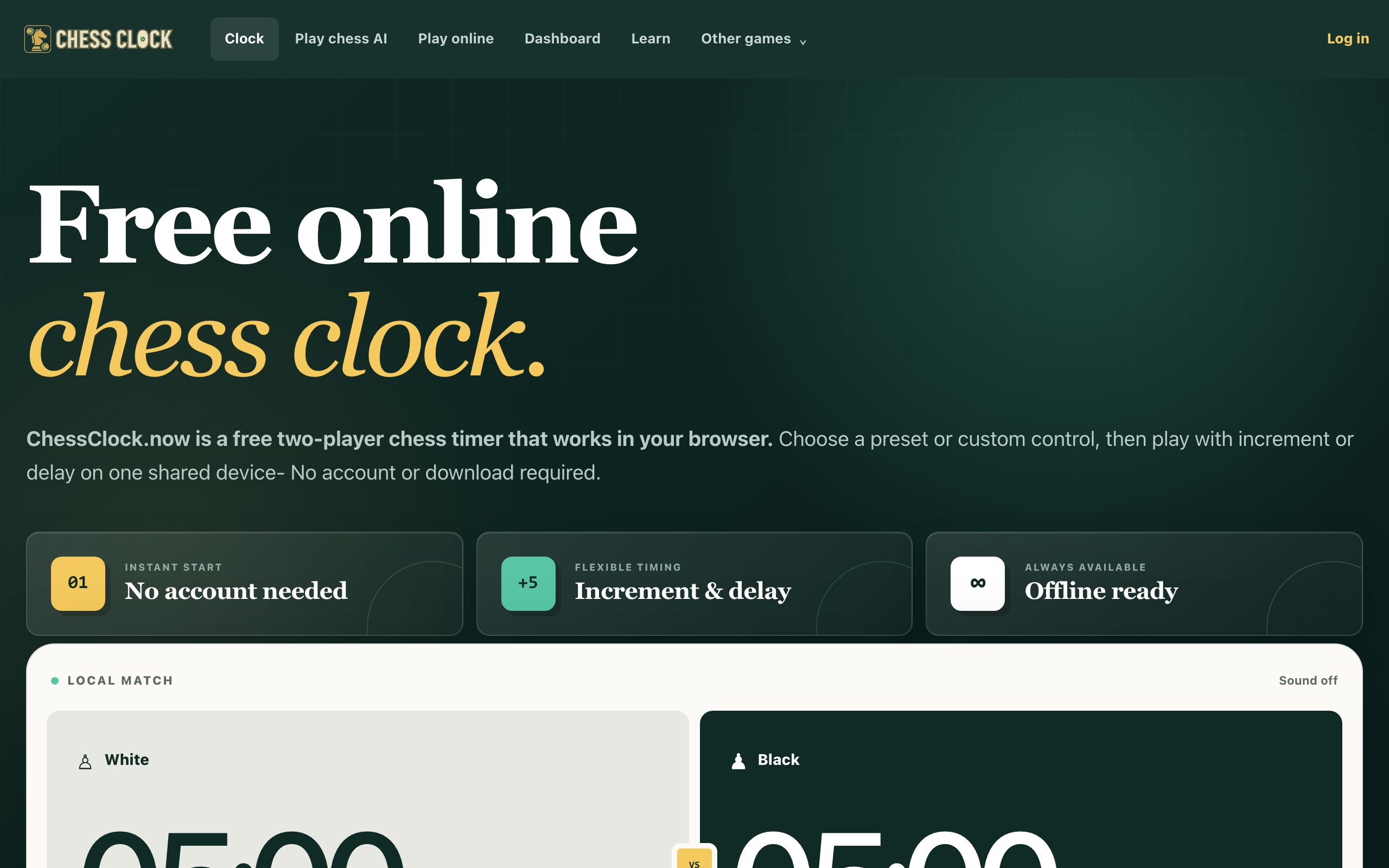
\nRelated reading: Play Chess Online With a Free Chess Clock (No Download), Where to Play Checkers Online Free (No Download), and Where to Play Reversi and Othello Online Free.