Running a sidechain typically costs $1,000–$5,000/month for a minimal validator set on bare-metal cloud, while deploying to a sharded mainnet costs near-zero in infrastructure but 100% of your costs shift to variable per-transaction fees and the non-negotiable expense of competing for blockspace during congestion.
The hidden infrastructure bill of sidechain vs sharding cost
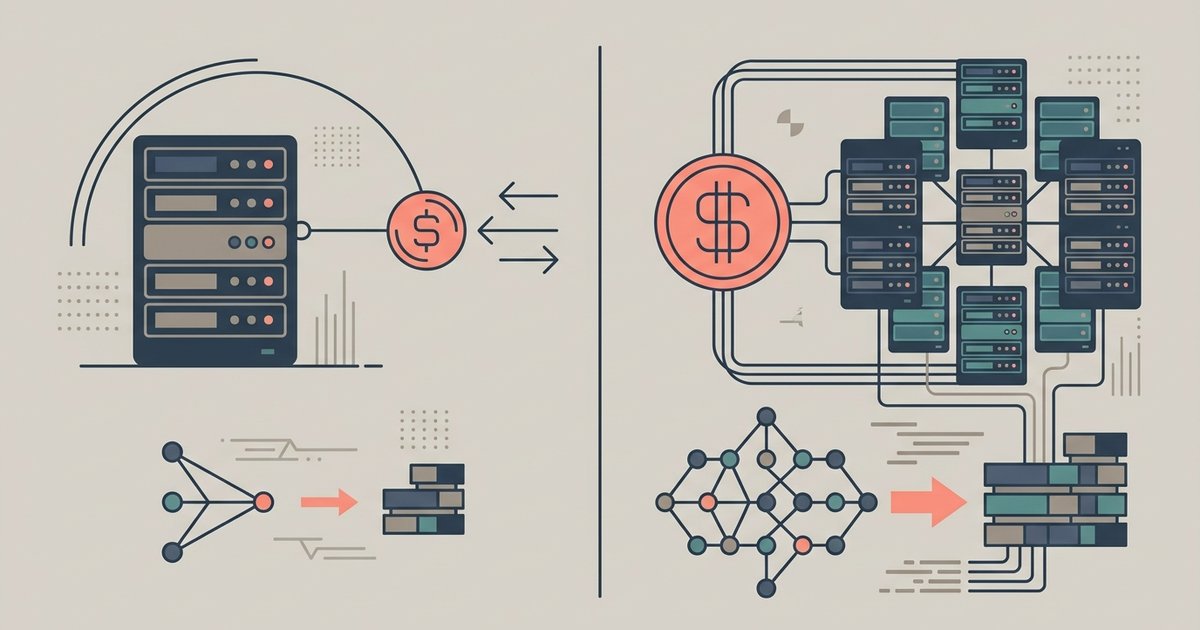
Bootstrapping a sovereign sidechain forces you to rent or own at least three to seven validator nodes on bare-metal cloud instances to maintain Byzantine fault tolerance. Each node costs roughly $300 to $700 per month as of the pricing published by AWS and Hetzner in early 2025. Check the current on-demand instance rates directly on each provider’s pricing page before budgeting. You must also provision sequencer nodes, archive nodes for state history, and a dedicated RPC endpoint cluster that can handle 10,000+ concurrent connections. “Cheap cloud instances” like a t3.medium tier fail under real user load. Sidechains need low-latency consensus rounds and large state databases that saturate burstable CPU credits within minutes. Add in monitoring tools, a block explorer, and a faucet for test tokens. Your fixed monthly bill then lands between $1,000 and $5,000 before a single user submits a transaction, according to the bare-metal instance pricing set by major cloud vendors. That cost is entirely sunk. You pay it whether the chain processes one transaction or one million.
Why sharded mainnets feel free until they don't
Deploying to a sharded mainnet like Ethereum’s shard chains or NEAR’s stateless shards costs you exactly $0 in servers, backups, or uptime monitoring at the infrastructure layer. The illusion of zero infrastructure cost evaporates when you examine the variable fee structure. Every user action incurs gas fees that spike during NFT mints, DeFi liquidations, or memecoin mania. On Ethereum, a simple ERC-20 transfer that costs $0.10 at 10 gwei can surge to $15 at 500 gwei during a single block of high demand, based on the gas market rates set by the network’s base fee algorithm. Visit the chain’s official gas tracker for live fee data. Priority fees add another layer. To get your transaction included before the next shard slot expires, you must outbid every other user in your shard’s mempool. State growth rent also looms. Shards charge storage fees that compound as your on-chain data accumulates. Those fees are denominated in the native token, which can itself appreciate or depreciate. A startup that processes 100,000 transactions per month at average fees of $0.50 pays $50,000. That is ten times the sidechain’s fixed cost. The figure doubles during a single congestion spike. A sidechain in blockchain avoids this auction entirely by letting you pay a predictable monthly server bill instead of per-transaction gas. The phrase “sharding in blockchain” describes the architectural goal of distributing load across parallel execution environments. It does not eliminate the core economic reality that blockspace is a scarce resource auctioned to the highest bidder.
The mistake of comparing a sidechain's fixed cost to a mainnet's average fee
Teams routinely budget using an L1’s average transaction fee from a quiet week. They might use $0.05 on BNB Chain as quoted by the network’s own gas tracker at a low-congestion moment. They then conclude that a $3,000 per month sidechain is wasteful. This arithmetic ignores tail-risk congestion pricing. In March 2024, a single NFT drop on Ethereum caused base fees to spike to 1,200 gwei for six consecutive hours. A simple token swap cost $120 during that window, as recorded by the on-chain fee history. A startup processing 5,000 transactions during that window would pay $600,000. That sum exceeds a decade of sidechain operation at $5,000 per month. The failure is structural. Average fees are backward-looking and ignore the non-linear relationship between demand and gas price. When you choose a blockchain, you are not just selecting a technology stack. You are selecting a pricing mechanism. Sidechains let you cap your worst-case monthly spend. Sharded mainnets expose you to unbounded variable costs driven by external events you cannot control. Before committing, examine the bridging infrastructure you will need. Sidechains require a bridge to the mainnet, which adds latency and security overhead. Sharded mainnets rely on native cross-shard messaging that is free but slow. If your use case requires settling fiat revenue, you must also connect your blockchain to a bank account via on-ramp providers. Those providers charge per-transaction fees that stack on top of your chosen chain’s costs. The bottom line is a distinctive truth no other cost-comparison page states this bluntly: a sidechain’s fixed overhead is a known, manageable expense, while a sharded mainnet’s variable fees are a silent drain that can spike without warning.