Before you start: connect and identify your external hard drive
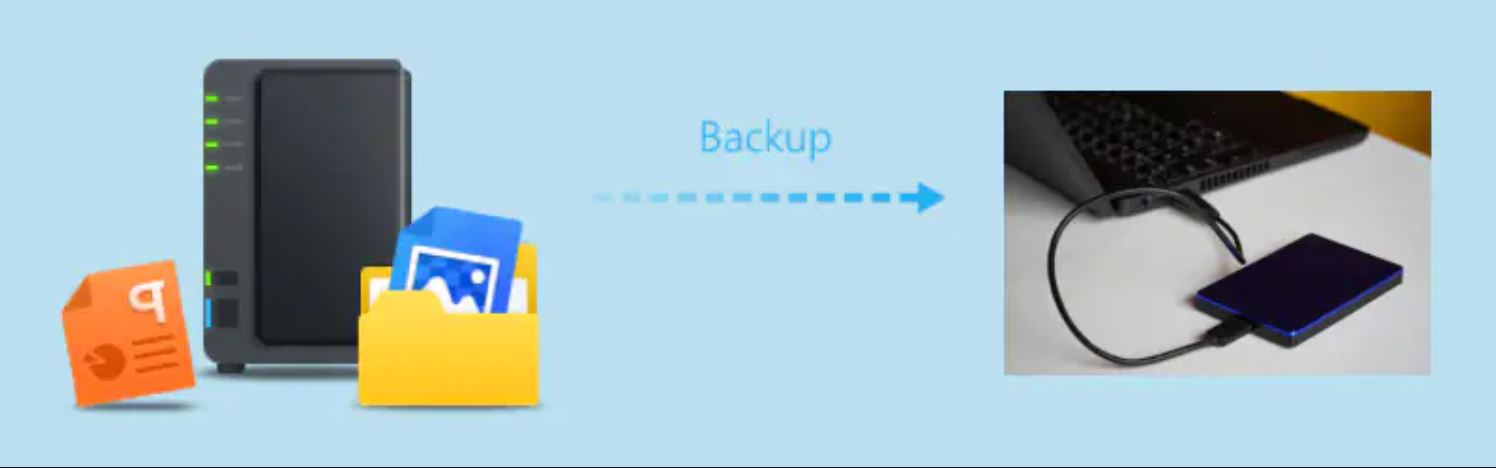
To copy files from Synology NAS to external hard drive, you connect the drive to a USB port on your NAS, and DSM will automatically create a shared folder named usbshare[number] for it. The entire process works through the DiskStation Manager interface, and you can use either the automated USB Copy package or the manual File Station method. Physically plug the external drive into any available USB port on your Synology NAS and make sure it is powered on. Log into DSM and open Control Panel, then go to External Devices to confirm the drive is recognized. The NAS names the drive usbshare1, usbshare2, and so on, depending on how many USB devices you have connected. Synology NAS supports Btrfs, ext3, ext4, FAT32, exFAT, HFS, HFS Plus, and NTFS formats. If your drive is not recognized, you may need to format it; the NAS can format external drives to ext4 or FAT32. Keep in mind that ext3 and ext4 drives are only readable by the NAS, not by a PC or Mac. FAT32 works on both PC and Mac but has a 4GB file size limit, so any single file larger than that will fail to copy. For exFAT drives, DSM 7.3 and above include the license by default, but older DSM versions may require a separate license purchase. If you are consolidating cloud data onto the same drive, you can also move files from iCloud to external hard drive for a complete local backup, or move files from Google drive to external hard drive to unify your cloud storage offline.
Method 1: copy files automatically with USB Copy (recommended)
USB Copy is the easiest way to copy files from Synology NAS to external hard drive because it runs without manual intervention once configured. It is ideal for routine backups, and you can set it to trigger every time you plug in the drive. To begin, open Package Center in DSM and install the USB Copy package. Once installed, open USB Copy and click the Create button (the plus icon). Select Data Export as the task type. You will then choose between two copy modes: Multi-versioned or Mirroring. Multi-versioned keeps multiple copies of files with timestamps, which is useful if you want to preserve older versions. Mirroring makes the external drive an exact replica of the source folder, deleting any files on the drive that no longer exist on the NAS. After selecting a mode, choose the source folder on your NAS and the destination folder on the external drive. USB Copy tasks are limited to one folder selection per task, so if you need to copy multiple folders, create separate tasks for each. Only administrators or users in the administrators group can access USB Copy. You can configure the task to run automatically when the USB device is plugged in, on a fixed schedule, or by pressing a hardware Copy button on your NAS model if it supports one. USB Copy also offers an option to automatically eject the external drive after the task completes, which is a convenient safety feature.
Method 2: copy files manually with File Station
File Station gives you full control over the copying process, which is helpful when you only need to transfer specific files or folders occasionally. This method also leaves the files in their original readable format on the external drive, so you can access them from any computer later. Open File Station from the DSM desktop. Navigate to the directory on your NAS where the files you want to copy are located. Select the files or folders by clicking the checkboxes next to them, or select everything in the current directory by clicking the checkbox at the top-left of the file list. With the items selected, right-click on one of them and choose Copy from the context menu, or use the Action menu at the top and select Copy. The selected items are now in the clipboard. Next, in the same File Station window, navigate to the usbshare[number] folder that represents your external hard drive. Right-click on an empty space inside that folder and select Paste, or use the Action menu and choose Paste. File Station will begin copying the files from your NAS to the external drive. The transfer time depends on the total size of the files, the number of files, and the speed of both your NAS and the external drive. You can also drag and drop files directly from the NAS folder to the usbshare[number] folder in the other pane, which is faster for small transfers. File Station supports selecting multiple files and folders at once, so you can copy a batch of files in a single operation.
How to monitor the transfer and safely eject the drive
While the copy is running, you should keep an eye on the progress to catch any errors early. File Station shows a progress bar at the bottom of the window that displays the percentage of files copied and an estimated time remaining. You may also see a notification icon in the system tray of DSM that indicates the transfer is in progress. If your NAS has a Transfer Manager application, you can open it to see more detailed information such as transfer speed, completion status, and any warnings or errors. A stable connection between the NAS and the external drive is essential throughout the transfer; any interruption can cause data corruption. Once the transfer is complete and you have confirmed that all files are on the external drive, you must safely eject the drive before unplugging it. Open File Station and locate the external drive in the folder tree. Right-click on the drive icon or the usbshare[number] directory and select Eject or Safely Remove from the context menu. You can also right-click the external drive icon on the DSM desktop and choose Eject. Wait for DSM to finish the ejection process, which ensures all pending read and write operations are flushed to the drive. After the ejection completes, you can safely disconnect the USB cable from your NAS. Skipping this step risks data loss or corruption if files are still being written when you unplug the drive.
When to use Hyper Backup instead
USB Copy and File Station are both designed for simple file transfers, but if you need to back up the entire system, including applications, settings, and user configurations, Hyper Backup is the right tool. Hyper Backup is a separate package you install from Package Center. After installation, click the plus icon and select Data backup task, then choose Local folder & USB as the destination. The wizard will guide you through selecting source folders and configuring options like encryption, compression, and backup rotation. The critical difference is the output format: USB Copy and File Station leave your files in their original readable format on the external drive, so you can plug the drive into any computer and access the files directly. Hyper Backup stores data in a proprietary .hbk format that requires Hyper Backup Explorer to read on a computer. If you want to use a LaCie external hard drive for simple file transfers, USB Copy or File Station is the better choice. Choose USB Copy or File Station when you need readable files on the external drive, and choose Hyper Backup only when you need a full system backup with application and configuration data.