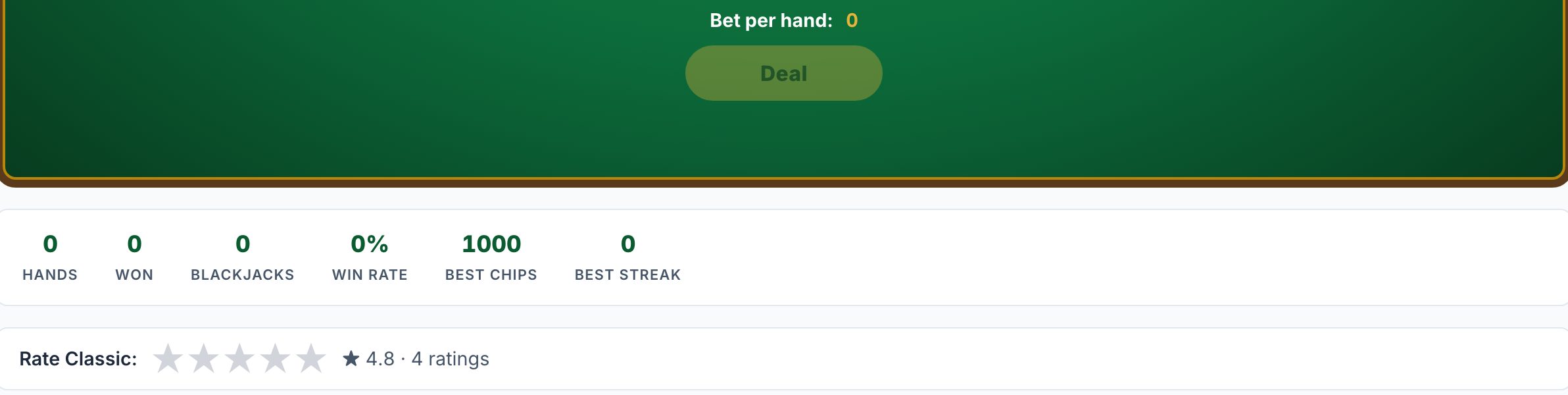
You can play Blackjack right now in your browser tab at Blackjack.ooo, no download, no account, no install. The game loads directly on the page, and you can close the tab the moment you are done. It is free, immediate, and works with a mouse or keyboard.

How the Game Actually Works (Refresher)
If it has been a while, here is the core loop. You are dealt two cards face up. The dealer gets two cards, one face up and one face down. Number cards count as their value. Face cards (J, Q, K) count as 10. An Ace counts as 1 or 11, whichever is better for your hand. Your goal is to get closer to 21 than the dealer without going over 21. If you go over, you lose immediately. If the dealer goes over, you win. If you both have the same total, it is a push (a tie) and you get your stake back.
On your turn, you have a few options. Hit takes another card. Stand keeps your current total. Double lets you double your stake for one extra card only. Split is available when you have two cards of the same value, you play them as two separate hands. Surrender (where offered) lets you fold your hand for half your stake back before you draw.
The dealer must follow a fixed rule: they hit until they have 17 or more. That rule is not a choice, it is automatic. So your only real decisions are what to do with your own hand.
The Decisions That Separate a Good Player from a Bad One
Most people who think they are “bad at blackjack” are actually just making the same few mistakes every hand. The good news is that the correct play is learnable and logical. Here is what separates a strong player from a weak one.
Know When to Hit vs. Stand
The most common error is standing on a stiff hand (12-16) when the dealer shows a high card. If the dealer shows a 7 or higher, they are likely to make a hand of 17 or more. You should hit your 12, 13, 14, 15, or 16 when the dealer shows 7 or higher. Conversely, if the dealer shows a low card (2 through 6), they are likely to bust. Stand on your stiff hand and let them draw. The only exception is a 12 against a dealer’s 2 or 3, in that case, you stand because the dealer is more likely to bust with a 2 or 3 showing.
Double Down at the Right Time
Doubling is a powerful move, but only when the odds are in your favour. You should double on 11 against any dealer card except an Ace. You should double on 10 against a dealer’s 2 through 9. And you should double on a soft 16, 17, or 18 (Ace + 5, 6, or 7) against a dealer’s 3 through 6. The logic is simple: a 10 or 11 is a strong hand, and if the dealer is showing a low card, you want to press your advantage while you can.
Split Correctly
Splitting is not about emotion; it is about math. Always split Aces and 8s. Never split 10s or 5s. Split 9s against a dealer’s 2 through 6 and 8 through 9. Split 7s against a dealer’s 2 through 7. Split 6s against a dealer’s 2 through 6. Split 4s only against a dealer’s 5 or 6. The reason is that a pair of 8s is a terrible 16, but two separate hands starting with 8 are much better. A pair of 10s is already a strong 20, do not break that up.
Surrender When It Is Truly Bad
If surrender is available, use it only for the worst hands. Surrender a hard 16 against a dealer’s 9, 10, or Ace. Surrender a hard 15 against a dealer’s 10. That is it. Most other hands are better played out, even if they feel hopeless.
What to Look for in a Place to Play
Not all free blackjack games are created equal. When you are looking for a place to play in your browser, check for these things.
- No signup, no install: The whole point is to play immediately. If a site asks for an email or a download, move on.
- Proper rules: Look for 3:2 payouts on a natural blackjack (an Ace + a 10-value card). Some free games pay 6:5, which is much worse for the player. The site you are on now explicitly states 3:2 payouts.
- Multiple variants: A good free site will let you try different rule sets, some with surrender, some without, some with dealer standing on soft 17, some with different deck counts. This matters because it changes your strategy slightly.
- Practice value: The best free games let you play slowly, think through your decisions, and make mistakes without any pressure. That is how you build good habits.
- No hidden timers or pressure: You should be able to take your time. A good free game does not rush you.
Variants and Modes Worth Knowing
Classic blackjack is the baseline, but there are other ways to play that change the strategy in interesting ways. On the site linked above, you get 16 more variants beyond the classic game. Here are a few you might encounter and what they change.
Single Deck vs. Multi-Deck
Fewer decks are better for the player because they increase the chance of drawing a 10-value card. If you see a single-deck game, the strategy is slightly different, you should be more aggressive with doubling on 10 and 11. Multi-deck games (4, 6, or 8 decks) are more common and require a slightly more conservative approach.
Dealer Stands on Soft 17 (S17) vs. Dealer Hits on Soft 17 (H17)
A “soft 17” is a hand with an Ace counted as 11 (e.g., Ace + 6). If the dealer stands on soft 17, that is better for you. If the dealer hits on soft 17, that is worse for you. In H17 games, you should be slightly more aggressive with your own hands, double more often and hit more often on stiff hands.
Surrender Variants
Some games offer “late surrender” (you can surrender after the dealer checks for blackjack). Others offer “early surrender” (you can surrender before the dealer checks). Late surrender is the standard. If you find a game with early surrender, that is a significant player advantage, use it more often.
Daily Challenge and Live Multiplayer
If you want a bit of structure, the site offers a daily challenge and live multiplayer. The daily challenge gives you a specific hand to play against a fixed dealer hand. The live multiplayer lets you play at a table with other people who are also just practicing. Neither requires an account, and both are good for testing your decisions under a little time pressure.
Frequently Asked Questions
Do I need to create an account to play?
No. The game loads directly in your browser. There is no signup, no email, and no personal information required. You click the link, and you are playing.
Can I play with a keyboard or only a mouse?
Both work. The game is designed for a desktop or laptop browser. You can click the on-screen buttons with your mouse, or use keyboard shortcuts if the site offers them (most do). If you are unsure, just click, it is a point-and-click interface.
What is the difference between a “soft” and a “hard” hand?
A “soft” hand contains an Ace that can be counted as 11 without busting (e.g., Ace + 6 = soft 17). A “hard” hand has no such flexibility (e.g., 10 + 7 = hard 17). Soft hands are more flexible because you can hit without the risk of busting on the next card. This changes your doubling and hitting decisions.
Is it better to play with fewer decks?
Yes, from a probability standpoint, fewer decks are better for the player. This is because removing a single 10-value card from a single deck has a bigger impact than removing it from a six-deck shoe. That said, the difference is small, and you can win at any deck count if you play basic strategy correctly.
What is the single most important rule to remember?
Never take insurance. Insurance is a side bet that the dealer has a natural blackjack. It pays 2:1, but the probability of that happening is not in your favour. It is a sucker bet. Ignore it completely.
Now that you know the rules and the strategy, go ahead and play a few hands. The best way to learn is to do it, and you can do it right now, in this tab, for free.
More like this: Where to Play Classic Games Online Free · Free Classic Games You Can Play in Your Browser: The Directory
\nRelated reading: Where to Play FreeCell Online Free (No Download).