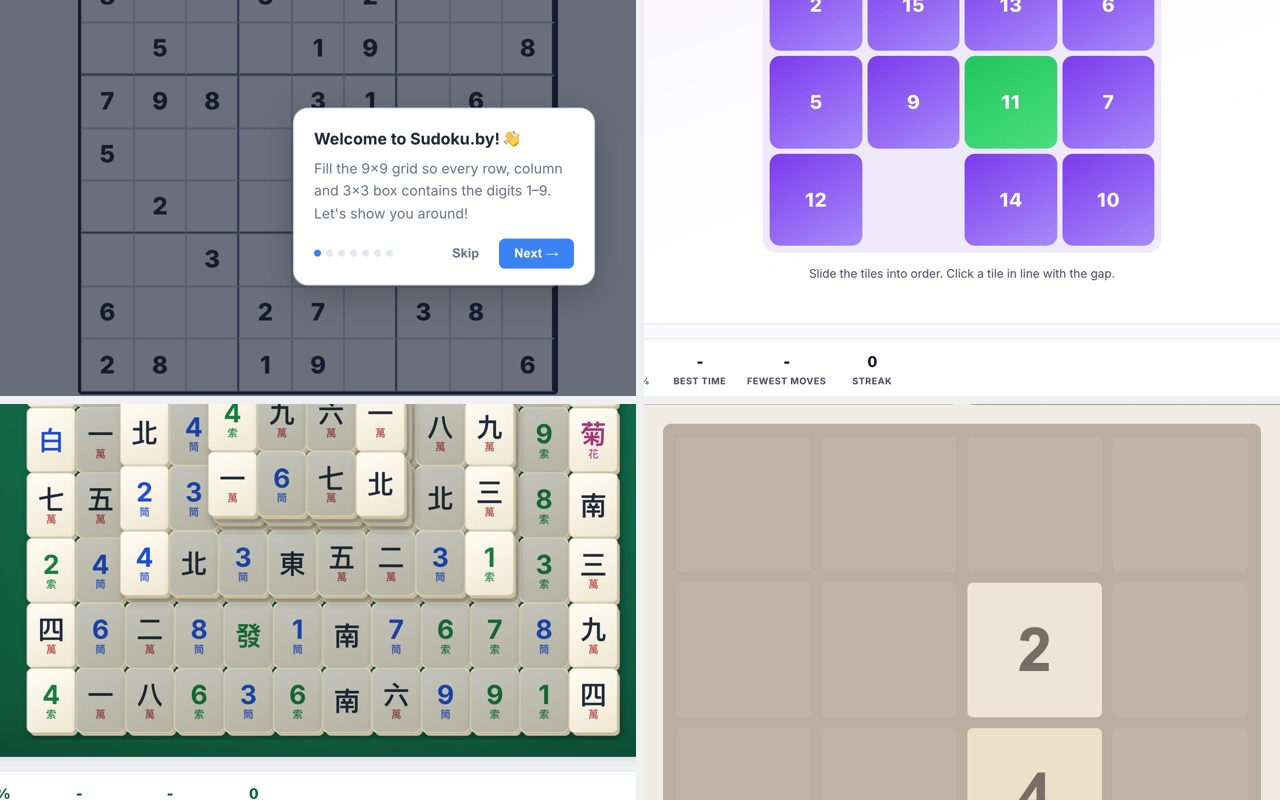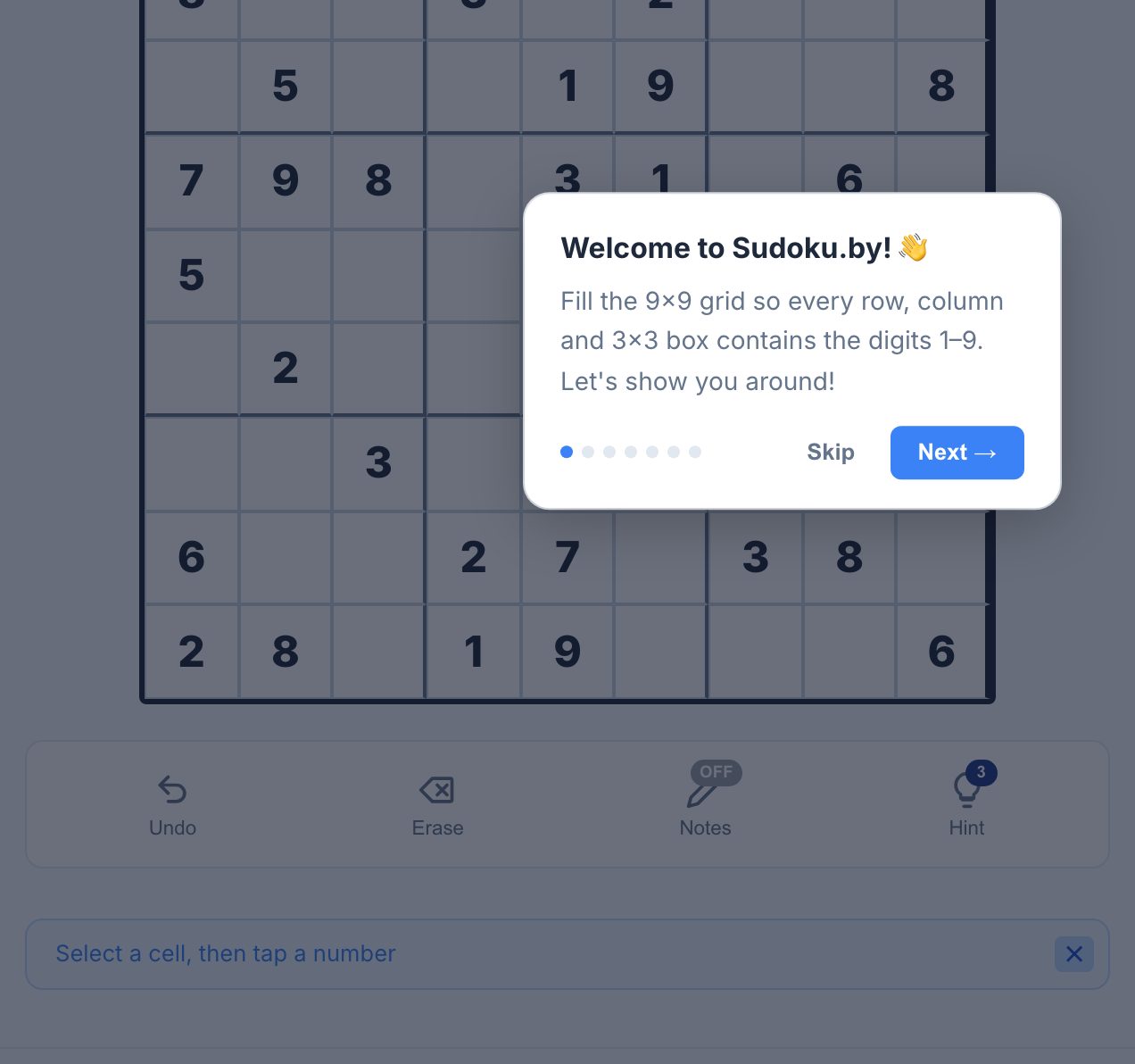
You can play Sudoku online free right now in your browser at Sudoku.by, no download, no account, no install. Just open the site, pick a difficulty, and start solving. It works on a desktop or laptop with a mouse or keyboard, and you can close the tab the moment you are done.

How Sudoku Actually Works (If You Haven't Played in Years)
The grid is 9x9, divided into nine 3x3 boxes. The goal is to fill every row, every column, and every 3x3 box with the digits 1 through 9. No digit can repeat in any row, column, or box. The puzzle starts with some cells already filled in, these are your clues. You never guess; every move is logically forced, even if the logic is complex.
For a beginner, the easiest way to start is to look for a row, column, or box that has eight numbers filled. The missing number is the only one that fits. That is a "naked single." Do this across the whole grid, and you will often crack the first few cells. Then you move to "hidden singles", a number that can only go in one cell within a row, column, or box, even if other candidates are present.
If you have not played in years, the key is to stop thinking of it as arithmetic. It is pure logic. You are not adding or multiplying; you are eliminating possibilities. Each cell can only contain one digit, and you are using the given clues to narrow down which digit that is.
The Decisions That Separate a Good Player from a Bad One
Bad players guess. They see a cell with two possible numbers, pick one, and if it leads to a contradiction, they backtrack. That works, but it is slow and error-prone. Good players never guess. They use systematic elimination.
- Scan first, then fill. Before you place a single number, scan every row, column, and box for obvious singles. Write in all possible candidates for empty cells (pencil marks). This takes a minute but saves you from re-scanning the same rows repeatedly.
- Look for "naked pairs" and "triples." If two cells in a row both only allow the same two digits (say 3 and 7), then no other cell in that row can be 3 or 7. You can eliminate those candidates from the rest of the row. This is a classic intermediate technique.
- Use "pointing pairs" and "box-line reduction." If a digit appears as a candidate in only one row within a 3x3 box, then that digit must go in that row somewhere in that box, so you can remove it from the rest of that row outside the box. This is a powerful way to break open a tough puzzle.
- Know when to use "X-Wing" and "Swordfish." These are advanced patterns. An X-Wing occurs when two rows each have the same candidate digit in only the same two columns. Then you can eliminate that digit from those columns in other rows. Swordfish is the same idea with three rows and three columns.
- Never guess, but do not get stuck either. If you are truly stuck, you made a mistake earlier. Go back and check your pencil marks. A single wrong candidate can cascade into a dead end.
The best players also use a systematic order: fill in all naked singles first, then move to hidden singles, then pairs, then triples, then advanced patterns. They do not jump around randomly. They also use the "last remaining cell" rule, if a row, column, or box has only one empty cell left, that cell must be the missing digit.
What to Look for in a Place to Play Sudoku Online
Not all Sudoku sites are equal. The one you choose should respect your time and your browser tab. Here is what matters:
- No account, no install. You should be able to click and play. If a site makes you register or download an app, it is wasting your time. The best sites load in a second and start instantly.
- Difficulty levels that actually differ. A good site offers at least Easy, Medium, and Hard. Better sites go further, Expert, Master, Extreme. The difficulty should change the solving logic required, not just the number of given clues.
- Daily challenges and leaderboards. These add replay value. A daily puzzle gives you a reason to come back. A leaderboard shows you how your solve time compares to others, but only if you care about that. If you just want a quiet puzzle, you can ignore it.
- Variants. If you finish classic Sudoku, variants like Killer (cages with sums), Diagonal (both main diagonals also contain 1-9), or Irregular (jigsaw boxes) keep the logic fresh. A good site has at least a few.
- Clean interface. You want a grid that is easy to read, with clear numbers and a simple way to enter candidates. You should be able to use the mouse to click a cell and the keyboard to type a number. No flashy animations that slow you down.
When you find a site that does all that, you have a keeper. The one linked above, Sudoku.by, fits the bill. It has easy to extreme difficulties, daily challenges, leaderboards, weekly competitions, and 30+ variants. You can play with a mouse or keyboard, and it runs in a browser tab with no install.
Variants and Modes Worth Knowing
If you are new to variants, start with these three:
- Killer Sudoku. The grid is divided into cages, each with a small number in the corner. That number is the sum of the digits in that cage. No digit repeats in a cage. This adds arithmetic on top of logic, but it is still pure deduction.
- Diagonal Sudoku. The two main diagonals (top-left to bottom-right, and top-right to bottom-left) must also contain 1-9 without repetition. This gives you two extra lines to work with, which can actually make the puzzle easier in some spots.
- Irregular (Jigsaw) Sudoku. The 3x3 boxes are replaced with irregular shapes. The rule is the same, each shape must contain 1-9, but the shapes are not square, so the logic feels very different.
Each variant forces you to use a different part of your brain. If you are stuck on classic Sudoku, a variant can be a fun way to reset your thinking. The site linked above has 30+ variants, so you will never run out of new challenges.
Frequently Asked Questions
Can I play Sudoku on my phone or tablet?
Yes, but the site is designed for a desktop or laptop browser. On a phone, the grid is smaller and harder to tap accurately. If you are on a computer, use a mouse for precision. On a touchscreen, you can still play, but it is less comfortable.
Is there a timer or do I have to race?
No timer is required. You can take as long as you want. Some sites show a timer, but you can ignore it. The point is to solve the puzzle, not to beat the clock, unless you want to compete on the leaderboard, in which case a faster time is better.
What if I get stuck on a puzzle?
Most sites, including this one, let you start a new puzzle or restart the current one. You can also use the "check" or "hint" feature if the site has one, but be careful, because using hints may disqualify you from leaderboards. If you are truly stuck, walk away for an hour and come back with fresh eyes.
Is it really free, or are there hidden costs?
It is free. There is no account, no subscription, no paywall. You can play unlimited puzzles. The site may show ads, but that is how it pays for itself. You do not need to pay anything to play.
Can I play with the keyboard instead of the mouse?
Yes. Use the arrow keys to move the cursor between cells. Type a number to place it. To enter a candidate (pencil mark), hold Shift and type a number, or use the candidate mode button if the site has one. The keyboard is often faster once you get used to it.
More like this: Where to Play Classic Games Online Free · Free Classic Games You Can Play in Your Browser: The Directory
\nRelated reading: Where to Play 2048 Online Free (No Download).