You can play 2048 right now, in this browser tab, without installing anything or creating an account. Head straight to 2048.now and the game loads immediately. It works with your keyboard arrow keys or your mouse, and you can close the tab the moment you are done.

How the Game Actually Works
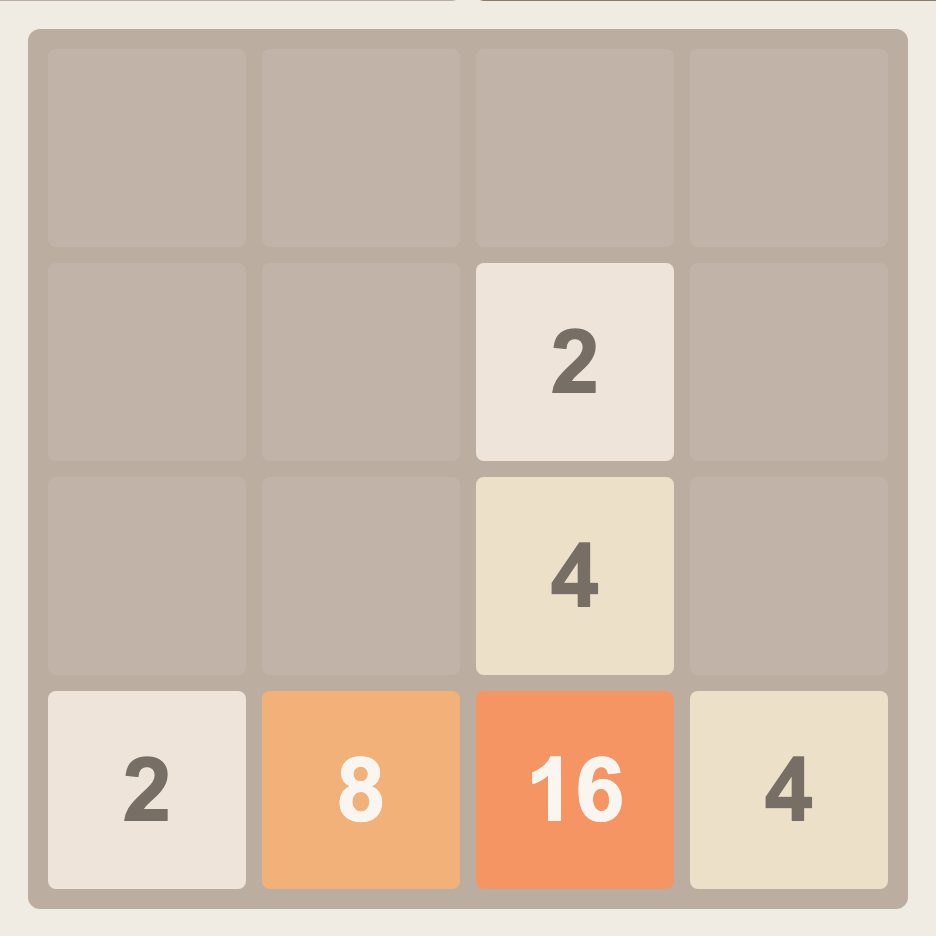
2048 is a single-screen sliding puzzle. You have a 4x4 grid, and every tile on it has a number that is a power of two (2, 4, 8, 16, and so on). When you press an arrow key, every tile slides as far as it can in that direction. If two tiles with the same number collide, they merge into one tile with the doubled value. A merge only happens once per move, so a row of 2-2-4-4 becomes 4-8 in a single slide, not 8-8.
After every move, a new tile appears in a random empty square. It is almost always a 2, sometimes a 4. The game ends when the grid is full and no adjacent tiles share the same number, meaning no more merges are possible. You win when you create a tile with 2048 on it, but you can keep playing after that to chase higher tiles like 4096 or 8192.
For someone who has not played in years, the core loop is deceptively simple: slide, merge, repeat. The challenge is not in understanding the rules, it is in managing the board so you never trap yourself into a dead end. The game gives you no timer, no score multiplier for speed, and no penalty for taking your time. The only pressure is the board filling up.
The Decisions That Separate Good Players from Bad Ones
Anyone can slide tiles around randomly and occasionally win. But consistent players make a few deliberate choices that dramatically increase their odds.
- Pick a corner and stay there. The most reliable strategy is to keep your highest tile in one corner, usually the bottom-left or bottom-right. You do this by only ever pressing the two keys that move tiles toward that corner, plus one of the perpendicular keys. For example, if your highest tile is bottom-left, you only press left, down, and occasionally up. You never press right. This keeps your big tiles from drifting into the middle of the board where they become hard to merge.
- Never move a tile away from your corner unless you have to. If your highest tile is in the bottom-left, pressing up is fine because it slides the bottom row up, but pressing right is dangerous because it pulls your high tile out of the corner. The rule of thumb: only use the two keys that push toward your corner, and the one key that pushes perpendicular. The fourth key is your emergency brake, used only when no other move is possible.
- Build a chain, not a pile. A common mistake is to merge tiles in the middle of the board, which creates a high tile that blocks your corner strategy. Instead, try to keep your tiles arranged so that the largest numbers are in a descending line from your corner. For instance, bottom-left corner has 1024, next to it 512, next to that 256, and so on. This way, when a new 2 or 4 appears, you can slide it into the lower end of the chain and merge it upward.
- Know when to break your own rule. Sometimes you will see a merge that looks tempting, two 128s side by side, but making that merge forces you to press the wrong key. In that situation, resist. A single bad move can cascade into a full board. The best players often sacrifice a potential merge to keep their structure intact.
- Watch for the "dead" row. If you are playing with your corner in the bottom-left, your top row is usually the "free" row where new tiles appear. If that row fills up with awkward numbers like 2, 4, 2, 4, you are in trouble because you cannot slide it left or right without disturbing your corner. The fix is to keep that top row as empty as possible, or at least keep its tiles small and mergeable.
None of this requires lightning reflexes. It is all about pattern recognition and restraint. The moment you feel you are "due" a good tile, you are actually just one move away from a dead end.
What to Look for in a Place to Play 2048
Not all 2048 versions are equal, and the site you choose matters more than you might think. Here is what to check before you commit your time.
- No install, no sign-up. The whole point of a browser game is that it runs in the tab. If a site asks for an email address or a download, close it. A good version loads in under a second and runs entirely in your browser.
- Keyboard and mouse support. You should be able to play with arrow keys, but a mouse-friendly option is a plus if you are on a laptop trackpad. The best versions accept both without any configuration.
- Undo and restart. A single misclick can ruin a 15-minute run. A good version has an undo button (often one or two moves deep) and a clear restart option. If a site does not offer undo, you are playing on hard mode.
- Score and best tile tracking. The game is about reaching 2048, but most people also care about their score. A good version shows your current score and your best score, and it saves your best in your browser's local storage so you can close the tab and come back later.
- Clean, uncluttered interface. You want to see the grid, your score, and the controls. You do not want pop-ups, auto-playing videos, or a dozen other games cluttering the screen. A clean layout means fewer distractions and fewer accidental clicks.
The site linked above, 2048.now, covers all these bases. It is a straightforward version of the classic puzzle, with the sections you need to learn and play, and nothing you do not.
Variants and Modes Worth Knowing
The original 2048 is a pure slide-and-merge puzzle, but the format has spawned several twists. If you finish the classic game and want a change of pace, look for these modes on the site you are using.
- Classic mode. This is the standard 4x4 grid with the goal of 2048. It is the default and the most balanced. If you have not played in years, start here.
- Small grid (3x3 or 5x5). A 3x3 grid is brutally hard because space runs out fast. A 5x5 grid is more forgiving and allows for longer games. Both change your strategy significantly. On a 5x5, you can afford to be more aggressive with your corner strategy because you have more room to recover.
- Timed mode. Some versions add a countdown timer, forcing you to make a move every few seconds. This changes the game from a thoughtful puzzle into a twitch reaction test. It is fun for a challenge, but it is not the classic experience.
- Undo-heavy mode. Some versions give you unlimited undo, which effectively turns the game into a puzzle you can solve perfectly. This is great for learning, but it removes the tension.
For most people, the classic mode is the right choice. It is the purest expression of the mechanic, and it is what the game's design is balanced around. If you want a different challenge, try a 3x3 grid for a quick, brutal session, or a 5x5 grid for a longer, more relaxed one.
Frequently Asked Questions
Can I play 2048 with just a mouse?
Yes. On the linked site, you can click and drag on the grid to slide tiles in that direction. Alternatively, you can use the on-screen buttons if they are present, but dragging is the most direct mouse method. Keyboard arrow keys work too, so you have options.
What is the highest score possible in 2048?
There is no single "highest" score because the game can continue indefinitely as long as you keep merging. The theoretical maximum for a 4x4 grid is 3,932,156 points, but that requires perfect play and a lot of luck with tile spawns. In practice, most players win the game (reach 2048) with a score between 20,000 and 40,000. The real limit is your patience, not the game.
Is 2048 a game of luck or skill?
It is both. The skill is in your decision-making: where you move tiles, when to merge, and how you manage the board. The luck comes from the random spawn of new tiles (2 or 4) and their positions. A skilled player can win most games, but even the best player will occasionally lose to a bad sequence of spawns. The balance is roughly 70% skill, 30% luck, depending on how aggressive you play.
Can I pause the game and come back later?
Yes, but only if you leave the tab open. The game state is held in your browser's memory, so closing the tab resets your progress. If you need to step away, leave the tab open and the game will wait for you. Some versions save your best score in local storage, but the current game board is not saved unless the site explicitly offers a save feature.
Why do I keep losing even though I know the strategy?
Knowing the strategy and executing it are two different things. The most common mistake is pressing the wrong key out of habit, especially when you are trying to move fast. Slow down. Before every move, look at the board and ask yourself: "Does this move keep my highest tile in the corner?" If the answer is no, find another move. Also, remember that sometimes the correct move is to press a key that does not merge anything, just to shift the board and give yourself more room. Losing is part of the learning process, every dead end teaches you a new pattern to avoid.
More like this: Where to Play Classic Games Online Free · Free Classic Games You Can Play in Your Browser: The Directory
\nRelated reading: Where to Play Sudoku Online Free (No Download).