




A temporary email address lasts anywhere from a few minutes to about a week, depending on the service, and a few services keep the address itself working indefinitely while deleting the messages. Temp mail is private from the site you signed up for, but it is not necessarily private from everyone else. On services with public inboxes, anyone who knows or guesses the address can read every message sent to it.
Those two questions, how long and how private, decide what you can safely use a given service for. Here is how they vary and what to check before you rely on one.
Three different clocks
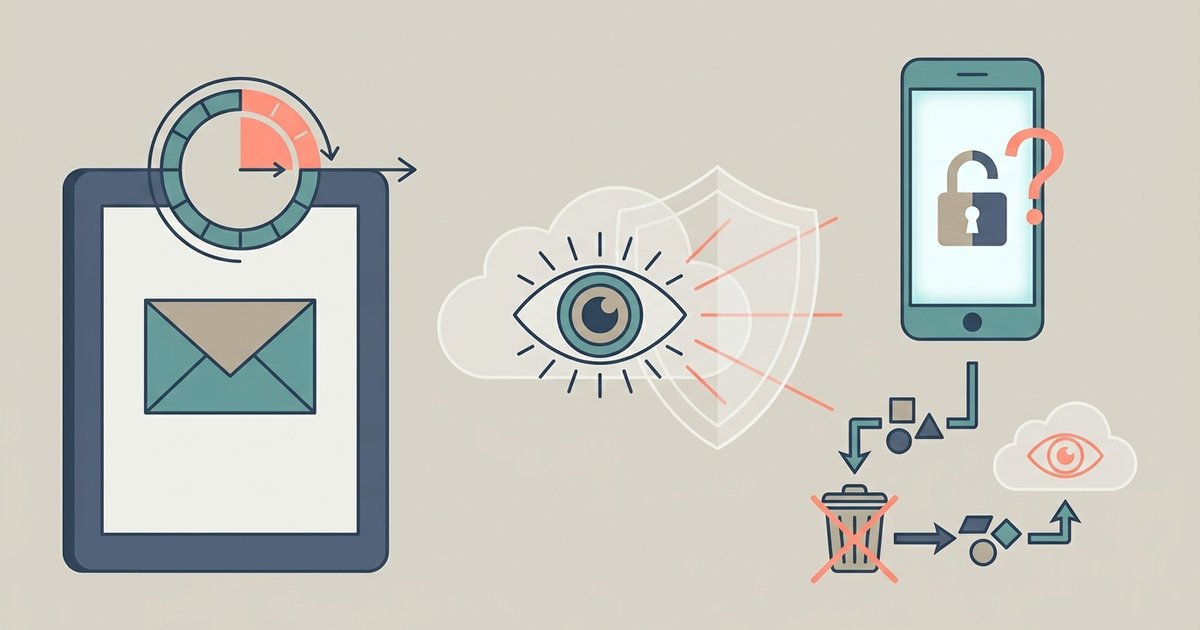
When a service says an inbox "lasts 10 minutes" or "keeps mail for a week," it can mean one of three different things, and they are worth separating.
How long you can see the inbox. Many services tie the inbox to your browser session. Close the tab, clear your cookies or switch devices, and you may lose access even if the address still technically exists.
How long messages are kept. Some services delete each message a set time after it arrives, regardless of whether the address is still in use.
How long the address works. Some addresses stop accepting mail when the timer ends. Others accept mail forever, because the service accepts every name on its domains, and anyone who types that name later gets whatever arrives.
The third point matters more than most people realize. An address that "expired" from your point of view may still be receiving mail, and on a public service, that mail may be readable by the next person who types the same name.
How long popular services last
These figures come from each service's own site or help pages. Services change their policies, so check the current terms before relying on any of them.
| Service | How long it lasts | Who can read the inbox |
|---|---|---|
| TempMail.now | A timer you choose, from 5 to 30 minutes, then the address and messages are deleted | Random address in your browser |
| 10 Minute Mail (10minutemail.com) | 10 minutes, with a button to add 10 more | Random address in your browser |
| Guerrilla Mail | Messages kept for 1 hour; addresses do not expire | Anyone with the inbox ID, unless you use its scrambled address |
| Maildrop | Inboxes with no new mail for 24 hours are cleared; 10 messages at most | Anyone who types the address |
| YOPmail | Messages kept for 8 days | Anyone who types the address |
| Mail.tm | Messages kept for 7 days; the mailbox stays until you delete it | Password protected |
| EmailOnDeck | No fixed time; usually most of a day, less if you clear cookies | Tied to your browser session and a recovery token |
| DropMail | Until you refresh or close the page | Tied to your open page |
A few patterns stand out. Short-timer services are built for a single code and clean up after themselves. Services that let you type any name are convenient, but that same convenience is what makes them public. And the services that last longest either use a password, as Mail.tm does, or make no promise of privacy at all.
Is temp mail private?
It depends on what you mean by private, and from whom.
From the site you signed up for: yes. The site sees a disposable address instead of your real one. It cannot add your real address to its marketing lists, sell it or leak it in a breach, because it never had it. This is the main reason temp mail exists, and it does this job well.
From other people: not always. On public inbox services such as Maildrop, YOPmail and Mailinator's free public inboxes, there is no password. Maildrop says so directly, describing its service as designed for little to no privacy. If you pick a common name like john123, other people may be reading the same inbox, and anyone who later types that name sees whatever is still there. Services that generate long random addresses, like TempMail.now and 10MinuteMail.now, are much harder to stumble into, but a random address is still a shared secret rather than a lock.
From the service itself: no. The operator runs the mail server and receives your messages in readable form. Most free services are paid for by advertising and analytics, and their consent banners list the partners involved. A good service says in its privacy policy how long it keeps mail and logs. Read it if the messages matter at all.
From tracking in general: only partly. A disposable address hides your email, not your IP address, browser or device. Marketing emails can also contain tracking pixels that report when a message is opened, and opening one in a temp inbox can still tell the sender that the address is being read.
What that means in practice
Match the service to what you expect to receive.
- A one-time code or confirmation link: any short-timer service with a random address works. A temporary inbox with a timer you choose lets you pick 5 minutes for a quick code or 30 minutes for a sender that is slow to deliver.
- Something that might take hours to arrive: use a service whose messages last at least that long, and keep the tab open if the inbox is tied to your session.
- Something you want to check again later: use a service with a password or recovery token, and write the credential down before you close the tab.
- Anything sensitive: do not use a temporary inbox. Password reset links, identity checks, financial details and personal documents should only go to an address you control, because on a public service a reset link can be used by anyone who sees it.
Can you get an expired address back?
Usually not, and that is by design. Short-timer services delete the address and its messages when the clock runs out and do not issue the same address again. Session-based services lose track of the inbox when your session ends. EmailOnDeck offers a recovery page that works if you have your email token and the address has not been wiped yet, and Mail.tm lets you log back in with the password it generated, although it cannot reset that password for you.
On public services the address never really goes away, so you can always type it in again. But you have no way to stop anyone else doing the same, which is why an account tied to a public inbox is only as secure as the address is obscure.
Before you use a temporary inbox, decide how long you need it and who you would mind reading it. If the answer to the first is "longer than today" or the answer to the second is "anyone," choose a password-protected service, a forwarding alias or your own address instead.