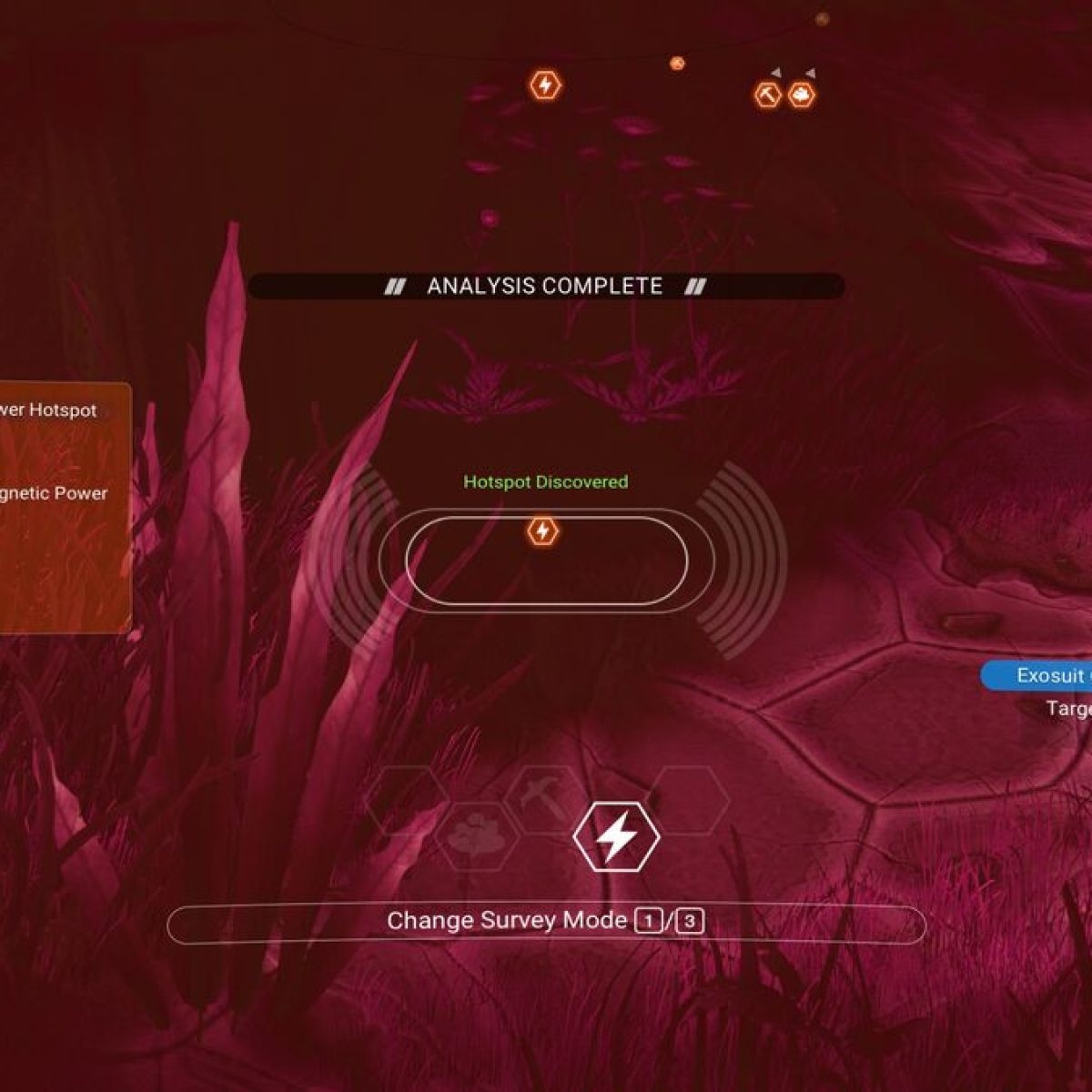
To begin locating power hotspot No Man's Sky, you need a Survey Device installed in your Multi-tool's Analysis Visor. This tool is the only way to reveal the hidden electromagnetic energy fields that can power your base indefinitely.
What you need for locating a power hotspot in No Man's Sky
Before you can start locating power hotspot No Man's Sky, you must first obtain the Survey Device blueprint. Head to the Anomaly (also known as the Nexus) and visit the Multi-tool vendor, Iteration: Eos, to purchase the blueprint. Alternatively, you can earn the Survey Device for free, along with its crafting ingredients, by progressing through the "Industrial Surveying" main story mission. Once you have the blueprint, you'll need to gather the required materials: Magnetic Resonator x3, Quantum Computer x1, and Wiring Loom x2. Craft the device and install it into your Multi-tool's Analysis Visor to begin your search.
How to use the Survey Device to find a power hotspot
With the Survey Device installed, follow these steps to locate a power hotspot:
- Activate your Analysis Visor by pressing the designated key or button.
- Switch to Surveying Mode using the toggle (e.g., SURVEYFILTERL or SURVEYFILTERR).
- Scan the surrounding terrain while looking for a lightning bolt icon on your visor display, this indicates a power hotspot.
- Listen carefully for audio cues: the beeping sound of the Survey Device will quicken as you get closer to a hotspot, and the pitch or frequency will change when you face its general direction, even if it's out of range.
- Follow the directional audio and the lightning bolt icon until you reach the hotspot's center, which is where the signal is strongest.
To pinpoint the exact center, keep moving toward the loudest, fastest beeping while watching the icon on your visor. The key is to center the sound of the hotspot on the surveyor and head in that general direction.
Understanding power hotspot classes and output
Power hotspots are rated by class: C, B, A, and S, with S-class offering the highest potential power output. Each class determines how much energy an Electromagnetic Generator placed on the hotspot will produce. A C-class hotspot generates 150kP per generator, B-class generates 220kP, A-class generates 250kP, and S-class generates up to 300kP. The power levels are also shown in the Survey Device as field strength: 15000 for C-class, 22000 for B-class, 25000 for A-class, and 30000 for S-class potential. For most base-building needs, an A or S-class hotspot is the ultimate goal, as it provides the most energy per generator and reduces the number of machines you need to build.
Quick tips for efficient hotspot hunting
When you're out scouting, using headphones, earbuds, or surround sound can make the audio cues more identifiable, helping you lock onto a hotspot's direction even before it appears on your visor. Knowing that at least one power hotspot is always within 1050u from any given location on a planet means you never have to wander too far, just pick a direction and systematically sweep the area. Once you find a hotspot, place your Electromagnetic Generators as close to the center as possible for maximum yield, since the farther away from the center a generator is placed, the less power it generates. You can place multiple generators within a single hotspot, subject to base complexity limits, but be aware that building too many leads to diminishing returns, most bases should not need more than around 10 generators on an A or S-class hotspot, or around 20 on a B or C-class hotspot. Hotspots do not deplete or lose potential over time, regardless of how much energy you harvest, so once you've secured an S-class power source, it will fuel your base forever. Power hotspots also tend to be more generous in terms of distance before power levels drop off significantly compared to mining or gas hotspots, giving you more flexibility in where you can place your generators. Finally, remember that there are always at least 16 hotspots (including power, mineral, and gas) available within 1050u from any location, and these always include at least one of each type: Power, Oxygen, Compressed Gas, Random Mineral, and an element specific to the system and biome, so if you find one type, keep scanning to locate the others nearby.
\nRelated reading: Understanding Eclipse Temurin JDK With Hotspot: Insights, How To Clear Cache On Playstation 4, and How To Reset Power Bank.