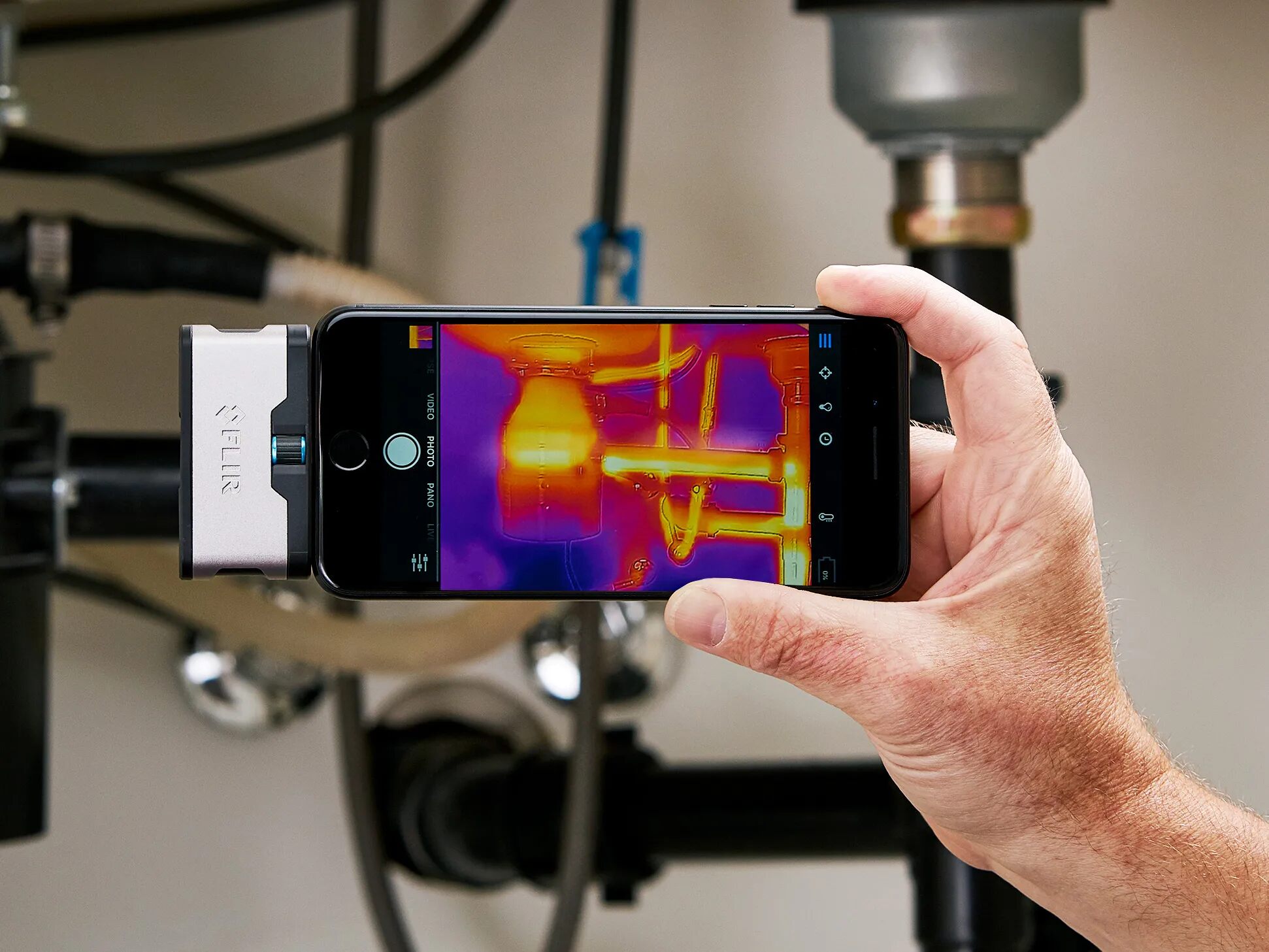
No, you cannot see through walls with a standard smartphone, and any app that claims to offer “X-ray vision” is either a scam or a visual parlor trick. While your phone’s camera is a marvel of engineering, it simply lacks the hardware to detect what’s behind drywall, brick, or concrete, but that doesn’t mean you’re out of options. By attaching specialized external devices like thermal cameras or RF-based scanners, you can turn your smartphone into a powerful tool that reveals studs, pipes, wires, and insulation issues hidden inside your walls.
Can you really see through walls with a smartphone?
The short answer is no, at least not with the phone you’re holding right now. Standard smartphones are equipped with cameras that capture visible light and some near-infrared, but they cannot penetrate solid materials like walls. The idea of pointing your phone at a wall and seeing pipes or studs through it is pure science fiction, and any app that promises this capability is misleading you. The only way to get close to “seeing through” a wall with your phone is by using an external hardware attachment, not software alone.
Why smartphone cameras cannot see through walls
Your phone’s camera sensor is built from silicon, which is optimized to detect visible light (the colors you see) and a small portion of near-infrared radiation. X-rays, which could theoretically pass through thin materials, require completely different detectors, bulky, expensive, and dangerous equipment that no consumer phone contains. Walls are made of dense materials like drywall, wood, brick, and concrete, and these block infrared radiation completely. Even if your camera could “see” heat, the wall itself acts as an opaque barrier, preventing any thermal signature from reaching the sensor. In short, the physics of light and the limitations of your phone’s hardware make it impossible for a standard camera to see through walls.
The truth about 'X-ray vision' apps
Search your app store for “X-ray scanner” and you’ll find dozens of apps that promise to reveal hidden objects or even “see through clothes.” These apps are scams. They use filters, post-processing tricks, or AI-generated effects to simulate transparency, but they are not actually detecting anything behind the wall. Some apps overlay generic images of pipes or studs onto your camera feed, while others use your phone’s accelerometer to create a fake “scanning” effect. The results might look convincing, but they’re purely visual illusions. There is no app on the market that can turn your phone’s camera into a true X-ray device, because the hardware simply doesn’t exist in any consumer smartphone.
How thermal imaging attachments work with your phone
If you want to see temperature differences on a wall’s surface, which can hint at what’s behind it, you need an external thermal camera. Devices like the Seek Thermal™ camera plug directly into your smartphone’s charging port (microUSB for Android, Lightning™ for iOS) and work with a dedicated app. These attachments detect infrared radiation emitted from the surface of objects, creating a heat map that your phone displays in real time. While thermal cameras cannot “see through” walls, they can detect surface temperature changes caused by heat transfer from objects behind the wall. For example, a warm heating duct will heat the drywall above it, creating a visible hot spot on the wall’s surface. Similarly, missing insulation might cause a cold patch, and a leaky pipe could create a damp, cooler area. The Seek Thermal camera, for instance, creates true thermal images with a resolution of 206 x 156 pixels, enough to spot these subtle differences, though not enough to see a human body behind a wall, which typically doesn’t warm the wall surface enough to be detected.
Using the Walabot DIY to detect objects inside walls
For a more direct approach, the Walabot DIY is an external device that attaches to your smartphone (iPhone 7 or higher, or Android 9.0 and above) and uses radio frequency (RF) technology to actually penetrate walls. Unlike thermal cameras that only read surface heat, the Walabot emits radio waves and measures how they reflect off objects behind drywall, plywood, or OSB. It can see through common building materials and penetrate insulation up to four inches deep, identifying pipes, electric wires, cables, and studs with impressive accuracy. To use it, you download the dedicated app, calibrate the device against a blank section of wall, and then run it along the surface. The app displays a real-time cross-section of what’s inside the wall, showing you exactly where to drill or cut. This is the closest you can get to true “see-through” technology with a smartphone today, and it’s a legitimate tool used by contractors and DIY enthusiasts.
What thermal cameras can actually detect behind walls
Thermal cameras are not magic, but they are incredibly useful for diagnosing home issues. By detecting surface temperature differences, they can reveal the location of heating ductwork (warm lines), missing insulation (cold spots), leaky pipes (damp, cool areas), and electrical faults (hot spots caused by resistance). These temperature anomalies on the wall’s surface are caused by heat transfer from the objects behind it, so while you’re not literally seeing the pipe or wire, you’re seeing its thermal footprint. However, thermal cameras cannot detect a human body behind a wall, the body’s heat doesn’t transfer through drywall and insulation enough to create a detectable surface temperature change. They also cannot see through walls made of brick or concrete, which block infrared radiation entirely. For realistic applications, think of a thermal camera as a tool for finding energy inefficiencies and potential hazards, not as a spy gadget.
What about night vision and future technologies?
Night vision cameras on smartphones, which amplify visible light or use near-infrared illuminators, cannot see through walls either, because walls block both visible and infrared light. However, researchers are actively working on a breakthrough. At institutions like the University of Texas at Dallas and Caltech, scientists are developing compact imager chips that use high-frequency radio waves in the terahertz or millimeter-wave band (200-400 GHz) to “see through” objects like walls, wood, plastics, and paper. These experimental chips are designed for close-range use (about one inch from an object) and use non-ionizing radiation, making them safe. The goal is to integrate these chips into future smartphones, allowing them to detect studs, wiring, or cracks in pipes behind walls. But this technology is still in the research and prototype phase, it is not available in any consumer phone today. So while your current smartphone can’t do it, the future might hold a different answer.
Practical tips for using wall-scanning tools
If you’re using a thermal camera or a Walabot-style scanner, here are a few tips to get the best results. First, always calibrate your device before scanning, this establishes a baseline reference point and improves accuracy. Second, scan slowly and methodically, moving the device in a grid pattern across the wall to ensure full coverage. Third, use a tripod or steady hand to avoid blurry or distorted images, and make sure your camera lens is clean. Fourth, take notes or screenshots of your findings and compare them with physical inspections or professional assessments. Finally, remember that these tools are supplements, not substitutes for professional advice, if you’re dealing with critical structural or safety concerns, consult a licensed contractor or electrician. And always obtain permission from the property owner before scanning walls, especially in rental or shared spaces.
Troubleshooting common issues
If your thermal camera or Walabot isn’t working correctly, start by checking the basics: ensure the device is properly connected to your phone, the app is up to date, and your phone’s battery is charged (wall scanning can be battery-intensive). If you’re getting inconsistent results, recalibrate the device against a known blank area of the wall. For blurry images, clean the camera lens and adjust the app’s focus or resolution settings. If the app crashes, close background apps, clear cache files, or restart your phone. And if you’re having compatibility issues, check the manufacturer’s website for a list of supported devices, not all apps work with every phone model. Finally, if you encounter persistent problems, reach out to the app’s technical support or consult online forums where other users share solutions.
Conclusion
While your smartphone cannot literally see through walls with its built-in camera, it can become a powerful diagnostic tool when paired with the right external hardware. Thermal cameras like the Seek Thermal reveal temperature differences that hint at ductwork, insulation gaps, and leaks, while RF-based devices like the Walabot DIY actually penetrate drywall to locate studs, pipes, and wires. These tools are invaluable for DIY projects, home inspections, and energy audits, but they have limits. They cannot detect human bodies behind walls, and they won’t give you X-ray vision. So, the next time you see an app promising to “see through walls,” save your money. Instead, invest in a legitimate thermal camera or RF scanner and use it responsibly, always supplementing your findings with professional advice when safety is at stake.
\nRelated reading: How To Clean Your Smartphone, How To Make A Smartphone, and How To Use Phone As VR Headset.