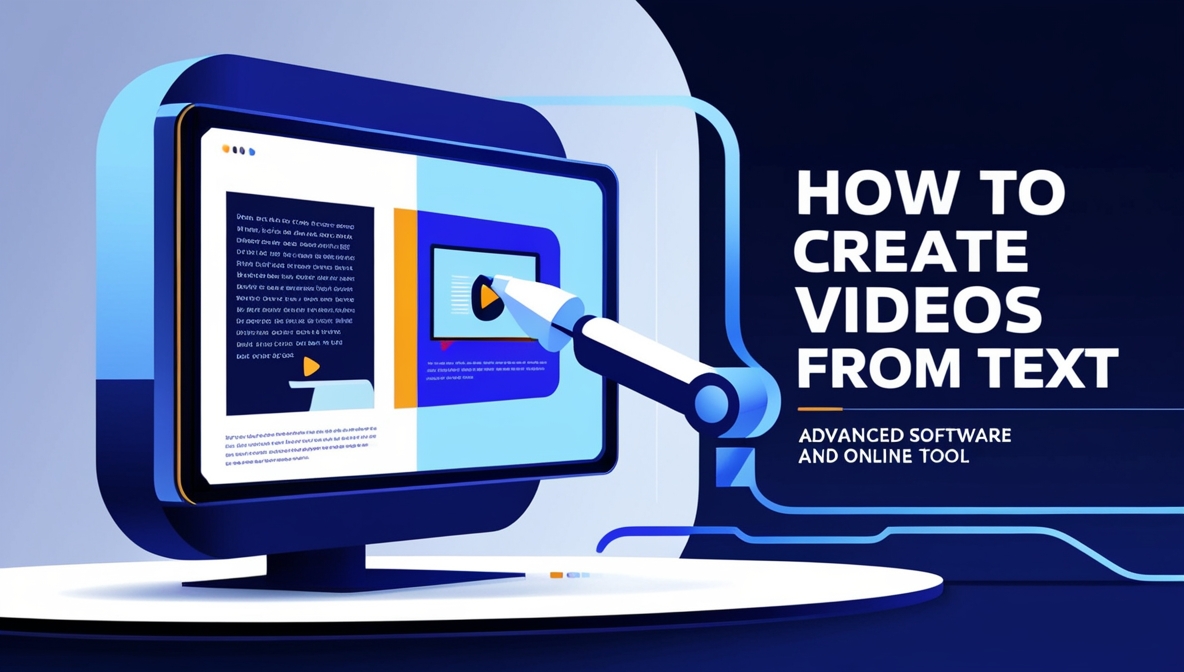
Yes, AI can create videos from text, and the process is faster and easier than ever. Modern AI tools analyze your written script or prompt and automatically generate complete video content, including scenes, visuals, voiceovers, and transitions, so you can create videos from text without any manual editing.
Can AI create videos from text?
AI video generators use natural language processing to understand your text and then match it with relevant visuals, animations, and audio. These systems handle everything from scene selection to timing, so you can turn a blog post, script, or even a simple prompt into a polished video in minutes. The technology has advanced to the point where the output is often indistinguishable from professionally produced content, and you don't need any video editing experience to get results.
How to create videos from text: the fastest AI video agent workflow
The quickest method to create videos from text is using a video agent, which is an AI system that works autonomously from a single instruction. Instead of manually configuring each element, you give the agent one text prompt describing the video you want, and it handles the entire production pipeline for you. This includes scripting, avatar selection, scene composition, and rendering, all without further input from you.
To use this workflow, start by writing a clear text prompt that describes your desired video, including the topic, tone, and any specific visual elements you want. The video agent then takes over, automatically generating a script, choosing an appropriate avatar, and composing scenes that match your description. Because the video is generated asynchronously, you don't have to wait for the process to finish before moving on to other tasks.
- Write a text prompt describing the video you want to create.
- Submit the prompt to the video agent, which begins processing automatically.
- Use the returned
session_idto track the progress of your video. - Poll the session to retrieve the
video_idonce rendering begins. - Access and download your completed video when rendering finishes.
General steps for turning text into video with AI
Regardless of which tool you choose, the core process for converting text into video follows the same universal pattern. You provide your written content, and the AI handles the heavy lifting of transforming it into a visual format. This approach works across all major text-to-video platforms, so once you understand the basic flow, you can apply it to any tool you encounter.
- Input your script by typing or pasting it into the designated area of the AI tool.
- Let the AI processing take over, which turns your script into a video complete with images and transitions.
- Review the generated video and make any necessary adjustments to the text, visuals, or audio.
- Export the final video in your preferred format and resolution.
How to create videos from text using advanced AI software (Filmora)
Filmora is a powerful AI-driven video editor that makes text-to-video conversion accessible to both beginners and experienced editors. Its key advantage is the combination of automated text processing with a full suite of manual editing tools, giving you complete control after the initial generation. The software's extensive stock library includes royalty-free images, music, and templates, so you can enhance your video without sourcing external assets.
Key features of Filmora for text-to-video
Filmora's AI text-to-video conversion automatically generates video content from your text input, saving you hours of manual work. The customizable templates let you match your video's theme, while the voiceover capabilities support both AI-generated voices and your own recordings. Advanced editing tools, including transitions, effects, and animations, allow you to refine the output, and the flexible export options ensure compatibility with any platform.
Steps to use Filmora for creating videos from text
- Download and install Filmora from the official website, following the installation instructions.
- Launch Filmora and open the AI text-to-video feature to start a new project.
- Paste or type your text content into the provided editor, and adjust the text language, video ratio, and voice settings.
- Click the text-to-video button to generate your video automatically.
- Customize the generated video by adjusting text placement, adding background music, and inserting images.
- Preview the finished video to ensure it meets your requirements, then export it to your local storage.
How to create videos from text via an online tool (Lumen5)
Lumen5 is an AI-powered online platform that transforms text content into engaging videos within minutes, with no prior video editing experience required. The platform analyzes your text input and automatically selects appropriate visuals, music, and transitions to match the narrative. Its drag-and-drop interface makes it one of the most accessible options for quick video creation, especially for social media content.
Key features of Lumen5
The user-friendly interface allows anyone to create videos without learning complicated software. The text-to-video conversion is the standout feature, automatically generating a storyboard with relevant visuals from your blog post or script. The extensive media library provides access to stock photos, videos, and music, while the customization options let you adjust colors, fonts, and layouts to align with your brand identity.
Pros and cons of Lumen5
The main advantages are the intuitive interface, quick conversion process, and variety of templates and customization options. However, the platform lacks advanced editing features, and the free version includes a watermark on your exports.
Steps to use Lumen5 for creating videos from text
- Sign up for a free account on the Lumen5 website and log in to access the dashboard.
- Choose a template that matches the type of video you want, such as Facebook, Instagram, or Twitter formats.
- Select your video layout, either from the premade templates or by uploading your brand's colors.
- Wait a few minutes for the software to create the video automatically.
- Edit the generated video by changing text, font size, layout, and other elements, then export the final file.
How to create videos from text using API integration
For developers who want to build text-to-video functionality directly into their applications, API integration offers the most flexible and scalable approach. This method allows you to generate AI videos programmatically, making it ideal for automated content pipelines, batch processing, or custom user-facing features. The process is straightforward and can be implemented with a few API calls.
- Submit a text prompt to the AI video generation API.
- Select the model you want to use for video generation.
- Configure the aspect ratio and duration for your video output.
- Poll the job status to check when the video is ready.
- Retrieve the generated video from the API response once processing completes.
FAQs on converting texts to videos
What is the best AI tool to convert texts to video? Filmora and Lumen5 are among the best options, offering a range of features that cater to both beginners and experienced editors. Filmora provides more advanced editing capabilities, while Lumen5 excels at quick, template-based creation.
Is there a GPT that creates videos? GPT models are primarily designed for text generation, but some AI tools integrate GPT-like technology to assist with scriptwriting and generating video content from text. These hybrid systems combine language understanding with video production capabilities.
Can I download videos created from text? Yes, all major text-to-video tools allow you to download videos in various formats and resolutions. The export options typically include MP4, MOV, and other standard formats, and you can choose the resolution based on your target platform. This makes it easy to repurpose your content across different channels, and you can also use third-party tools to download videos from online platforms if you need to save a copy for offline use.
How long does it take to create a video from text? The time varies depending on the tool and video length. Online tools like Lumen5 can generate a short video in a few minutes, while more complex software like Filmora might take longer for detailed projects. API-based solutions are asynchronous, meaning you can continue other work while the video renders.
What about the impact of AI writing on content creation? AI writing tools have fundamentally changed how content is produced, and this extends to video creation. The impact of AI writing on content creation is that it enables rapid generation of scripts, captions, and narrative structures, which can then be fed directly into video generators. This means you can go from a rough idea to a finished video in a fraction of the time it used to take, and the quality of the written content is often comparable to human-written scripts.
Choosing the right method for your needs
The best approach depends on your specific requirements. If you need the fastest possible turnaround and don't require much manual control, the video agent workflow is ideal. For content creators who want a balance between automation and editing flexibility, Filmora offers the most comprehensive feature set. Social media managers and marketers who need quick, branded videos will find Lumen5's template-based approach most efficient. Developers building custom solutions should use API integration for maximum control and scalability.
Each method has its strengths, and you can start with the simplest option and upgrade as your needs grow. The video agent workflow is perfect for testing ideas, Lumen5 works well for regular social media content, Filmora handles more polished productions, and API integration supports automated workflows at scale. All of these approaches share the same underlying technology, so the skills you learn with one tool will transfer to the others.
Start with the tool that matches your current skill level and content volume. If you're new to video creation, begin with Lumen5 or the video agent to see what AI can do with your text. As you gain confidence and need more control, move to Filmora for advanced editing. For developers, the API route offers the most potential for building custom video generation features into your own products and services.
\nRelated reading: AI Writing Tools That Actually Help You Sound Like a Human.