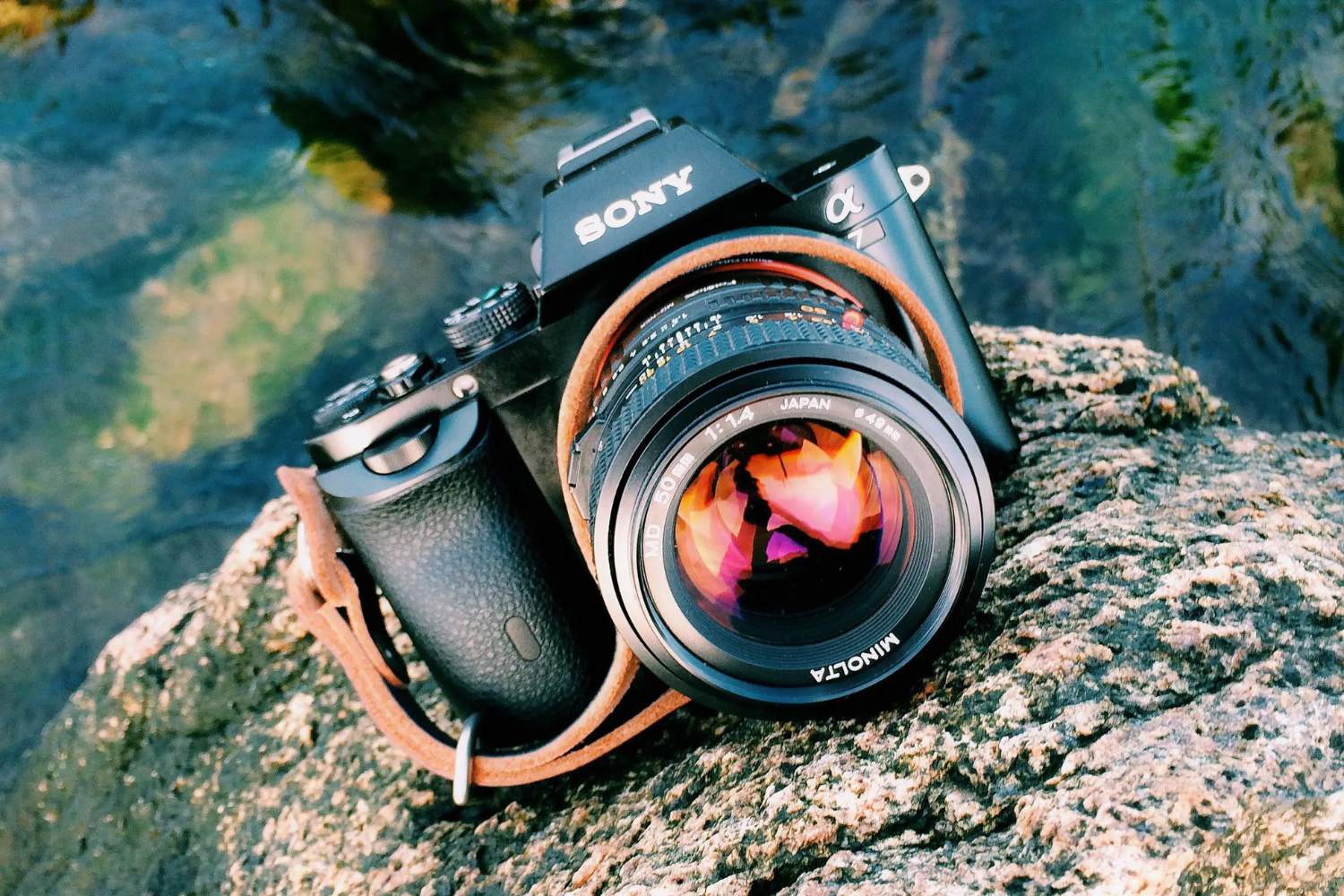
If you own older Minolta lenses, the best DSLR for you depends entirely on which mount they use: Sony A-mount DSLR and SLT cameras are the only DSLRs that natively support Minolta A-mount autofocus lenses, while older manual-focus MC/MD lenses won't mount on any DSLR without an adapter that degrades image quality. For a Sony dslr for minolta lenses, the answer is a used or new Sony Alpha A-mount body, not a Nikon or Canon, because those brands require glass adapters that add optical elements and compromise sharpness.
Which Minolta lenses work on a Sony DSLR?
The critical distinction is between Minolta A-mount autofocus lenses (introduced in 1985) and the older MC/MD manual-focus lenses (from the 1960s through the 1980s). Sony A-mount DSLRs and SLT cameras accept A-mount lenses directly, with full electronic communication, autofocus, and aperture control. Older MC/MD lenses have a completely different flange distance and mount diameter; they physically cannot attach to a Sony A-mount body without an adapter that includes corrective glass. That adapter introduces extra elements, which reduces sharpness, adds chromatic aberration, and often makes infinity focus unreliable. If you have A-mount lenses, you're in luck, native compatibility is seamless. If you have MC/MD lenses, no DSLR will give you the quality you want.
Sony A-mount DSLR and SLT cameras that fit your Minolta lenses
Every Sony Alpha DSLR and SLT camera with the A-mount supports Minolta A-mount lenses. The complete verified list includes the Sony Alpha a99 II, a99, a900, a850, a77 II, a77, a68, a65, a700, a580, a560, a550, a500, a450, a390, a350, a330, a300, a290, a230, a200, and a100. These span full-frame models (a99 II, a99, a900, a850) and APS-C crop-sensor models (all the others). Any of these bodies will physically mount your Minolta A-mount lens and provide full electronic communication. For crop-sensor bodies, remember that your lens's effective focal length multiplies by 1.5x, a 50mm lens behaves like a 75mm lens on APS-C.
How to check specific lens and body compatibility
Sony's official support website provides a searchable compatibility tool for A-mount lenses and bodies. To verify that a particular Minolta A-mount lens will function fully with a chosen Sony Alpha body, you can use that tool to check for any limitations. While nearly all A-mount lenses work on all A-mount bodies, some older third-party lenses or specific Minolta models may lack support for newer features like in-body image stabilization or phase-detection autofocus in video mode. The official tool gives you a definitive answer, so you can confirm that autofocus, aperture control, and stabilization all work as expected before you commit to a purchase.
What to expect when using older Minolta A-mount lenses
Older Minolta A-mount lenses on a Sony DSLR or SLT body deliver solid autofocus performance, though speed and accuracy depend on the lens's age and the camera's autofocus system. On SLT bodies (a77, a65, a99, a68, etc.), the translucent mirror enables continuous phase-detection autofocus during video and live view, which older lenses handle well. For manual focus assist, all Sony A-mount bodies offer focus peaking in live view (on SLT models) and magnified view; the a99 II and a77 II also provide focus peaking through the electronic viewfinder. Aperture control is fully electronic, so you adjust it from the camera body just as you would with a modern lens.
A better path for manual-focus Minolta MC and MD lenses
If your lenses are the older MC or MD manual-focus type, mirrorless cameras are the ideal home for them, not DSLRs. Mirrorless bodies have a shorter flange distance, so you can use a simple mechanical adapter without any corrective glass, this preserves the lens's original optical quality, allows infinity focus, and adds focus peaking and magnification for precise manual focusing. Sony E-mount cameras, Fujifilm X, Canon RF, and Nikon Z all work excellently with MC/MD lenses via adapters. A DSLR, by contrast, requires a glass adapter that degrades image quality, so you'll get far better results on a mirrorless body. For those who own MC/MD lenses, switching to a mirrorless system is the practical path to unlocking the full potential of that vintage glass.
\nRelated reading: How To Use A DSLR Camera With An iPhone, How To Use Canon EOS Rebel T7 DSLR Camera, and How To Digitize Old Photos With A DSLR Camera.