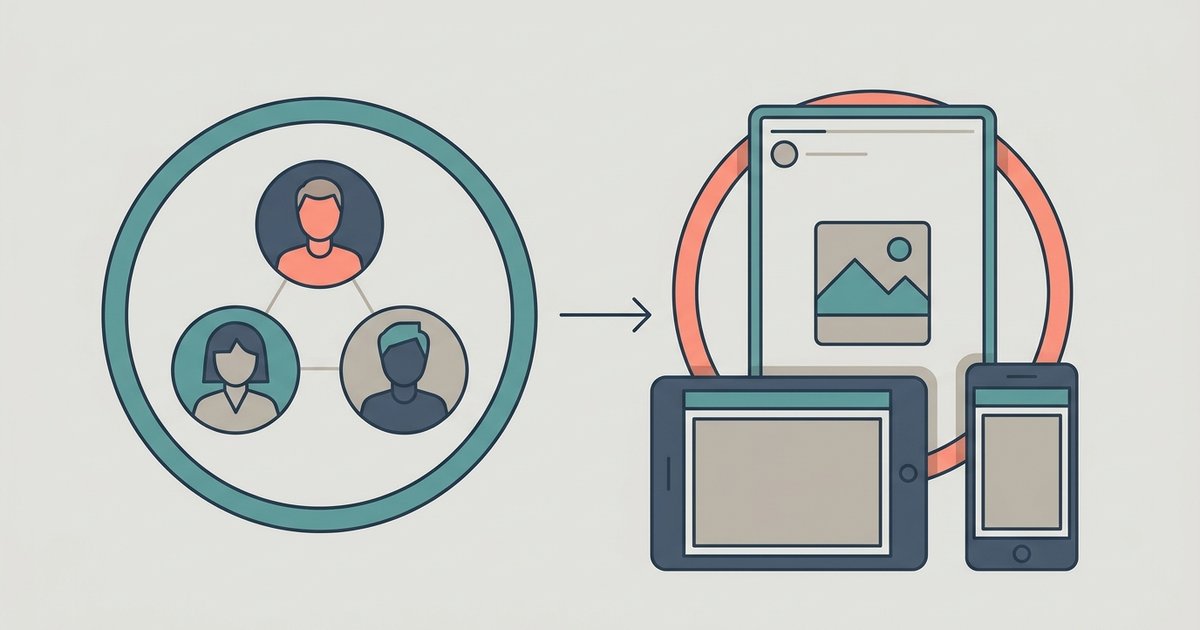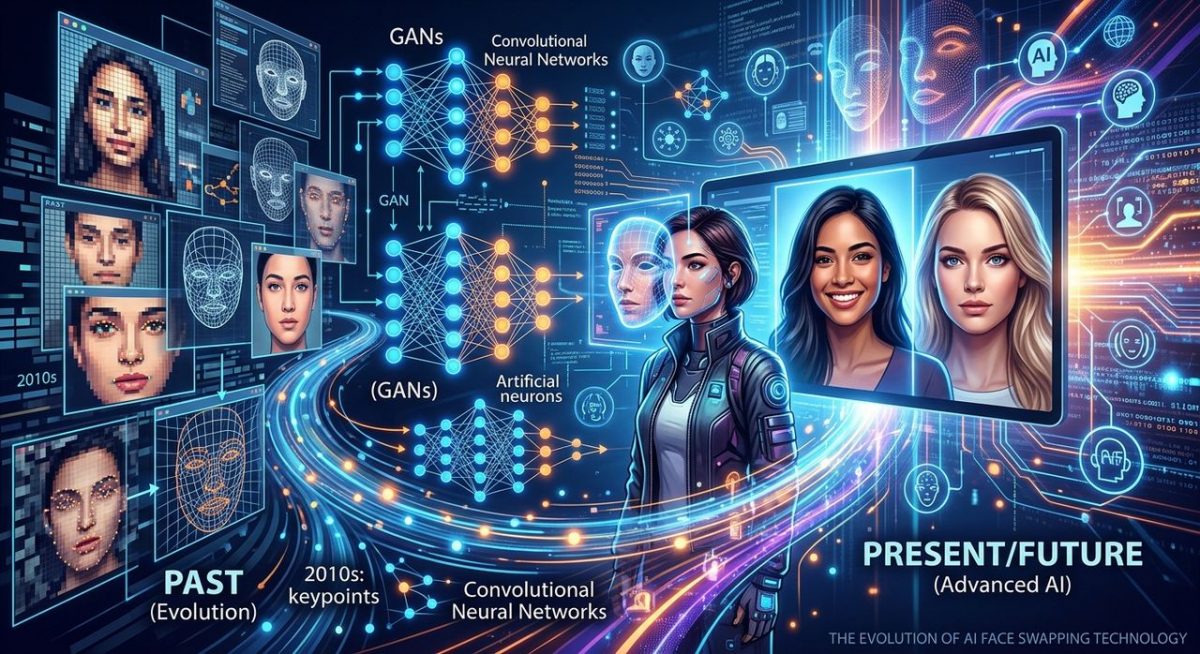
Face swapping used to be a Hollywood trick that required a team of visual effects artists, weeks of rendering time, and budgets most studios could barely justify. Today, a browser tab can do a convincing version of the same thing in seconds. That shift did not happen by accident. It came from years of compounding progress in computer vision, neural network architecture, and graphics processing, and understanding how those layers fit together tells you a lot about where this technology is headed next.
AI face swapping has crossed from specialized pipelines into consumer-grade tools, but the core math behind it is more accessible than you might expect.
– Modern systems use facial landmark detection to map dozens of anchor points on a face before any replacement happens.
– Transformer-based models now handle lighting, skin tone, and geometry in a single pass, replacing what used to require multiple separate processing stages.
– Browser-based equivalents bring the same results to any device without software installation, lowering the barrier for creative and educational use.
How Facial Landmark Detection Sets the Stage
Before any model swaps a face, it needs to understand the face it is working with. That process starts with landmark detection, which is the practice of identifying a precise set of points on a human face. These points typically cover the corners of the eyes, the tip of the nose, the edges of the lips, the jawline, and the outer edges of the eyebrows.
A classical approach used 68 landmarks. More recent systems use 478 or more, pulled from 3D mesh models that track the contour of the face as a geometric surface rather than a flat image. Once those points are mapped on both the source face and the target face, the algorithm can compute a transformation matrix that warps one set of coordinates onto the other.
This matters because face shapes are not uniform. Your forehead might be narrower or wider than the person whose face is being swapped in. The angle of the jaw might be different. Without a landmark grid to anchor the transformation, the result looks like a Halloween mask sitting at the wrong angle on someone else’s head.
What Transformer Models Changed
Earlier face-swap systems used convolutional neural networks, often organized in an encoder-decoder architecture. The encoder compressed the input face into a latent representation, and the decoder reconstructed it in the style of the target. This worked, but it struggled with occlusion, extreme head angles, and anything outside the training distribution.
Transformer models changed that dynamic. Instead of processing spatial features in a fixed local window, transformers use attention mechanisms that let the model weigh any part of the image against any other part. That global context allows the network to handle cases where part of the face is blocked by a hand, where the head is turned at a steep angle, or where the source and target face have substantially different proportions.
The practical result is that modern face-swap outputs look more coherent at the edges, particularly around the hairline, the ears, and the neck, which were historically the places where early results fell apart visibly.
Blending Skin Tones and Maintaining Lighting Consistency
Swapping the geometry of a face is only half the problem. The other half is making the replacement look like it actually belongs in the scene. Skin tone correction and lighting consistency are what separate a convincing result from an obvious composite.
Skin tone matching typically happens through color histogram transfer or through a dedicated neural branch that samples the dominant hue and luminance of the target face and applies a learned correction to the source pixels. This means that if the target has warm amber skin under a tungsten light, the swapped face will be shifted toward that same color temperature before compositing.
Lighting consistency is harder to solve. A face lit from the left will have shadows on the right. If the source face was lit from the front, the shadow structure will be wrong after the swap. Advanced models handle this through relighting networks or through normal map estimation, which computes the 3D surface orientation of the face and then re-renders it under the estimated lighting conditions of the target scene.
The Gap Between DeepFaceLab and Browser Tools
DeepFaceLab, which appeared around 2018 and remains one of the most documented open-source face-swap pipelines, required users to set up a Python environment, install GPU drivers, prepare training datasets of both faces, and run training sessions for hours or even days before any usable output appeared. The results were impressive for the era, but the barrier to entry kept most people away.
The contrast with today’s tools is significant. A no-install face swap tool running in the browser handles the model loading, preprocessing, and inference on the server side, so the user only needs to upload a photo. What took a machine learning practitioner a weekend of setup now takes a first-time user about thirty seconds.
That compression of effort came from a few converging factors: pre-trained models that ship ready to use, cloud compute that handles the heavy lifting, and model architectures that are efficient enough to run inference without requiring a dedicated GPU on the client side.
What Early Pipelines Actually Looked Like
To appreciate how far things have moved, it helps to know what the original pipeline stages involved:
- Face extraction, where frames from video were sorted and cropped to isolate the target face across different expressions and lighting conditions
- Alignment, where each cropped face was warped to a canonical position using the landmark coordinates so training would be consistent
- Training, where an autoencoder learned shared latent features between two faces over thousands of iterations
- Conversion, where the trained model applied the learned features to swap one face for the other, frame by frame
- Merging, where the swapped face was composited back into the original frame using mask blending and feathered edges
Each of those stages had its own parameters, its own failure modes, and its own community of users sharing configuration tweaks in forums. Today that entire sequence is abstracted behind a single upload button.
Legitimate Uses and the Industry That Grew Around Them
The word deepfake carries significant baggage, much of it earned through genuine misuse. But the broader history of synthetic face replacement includes documented legitimate applications that predate the controversies: digital de-aging in major film productions, performance capture for video game characters, dubbing localization where an actor’s lip movements are reshaped to match a translated script, and historical reconstruction projects where archival footage is animated for educational purposes.
The filmmaking industry used face replacement for decades under different names and with different tools. What changed is that the cost dropped low enough for independent creators, students, and hobbyists to access the same core capability. Comedy sketches, fan films, and artistic experiments now sit alongside professional productions as documented use cases for the technology.
The Ethical Guardrails That Followed
The misuse cases, particularly non-consensual synthetic media featuring real people, pushed the industry toward a set of technical and policy responses. Content authenticity initiatives introduced metadata standards that tag generated media at the file level, allowing platforms to identify synthetic content before it spreads. Detection models trained on compression artifacts introduced by face-swap systems have become part of platform moderation pipelines at major social networks.
Several jurisdictions introduced legislation specifically targeting synthetic media created without consent. Watermarking standards, both visible and imperceptible, are now built into commercial tools so that output can be traced back to the system that produced it.
The pace of the guardrails has not always matched the pace of the tools, and that gap remains a genuine challenge for regulators and platforms alike. But the direction is clear: the industry moved from treating this as an edge case to treating provenance and consent as engineering requirements that ship alongside the feature.
Where the Technology Stands Now, Six Years On
AI face swapping went from a graduate research curiosity to a browser-based consumer tool in roughly six years. The underlying shift was not just raw compute, though faster hardware helped. It was a fundamental rethinking of the architecture, from convolutional decoders that struggled with edge cases to transformer networks that handle occlusion, lighting, and geometric mismatch in a single forward pass.
The gap between what required a machine learning lab in 2018 and what runs in a browser tab today is a useful measure of how fast inference efficiency and model compression have moved. The same technology that enables creative experimentation also demands clearer standards around consent and provenance, and both of those conversations are actively happening at the same time. That tension is not going away, but the technical progress that created it is not going backwards either.
\nRelated reading: How to Fact-Check an AI Chatbot's Answer Before You Rely on It and Multi-Modal Perception Systems: Combining Vision, Language, and Sensor Data.