How To Use Ugee M708 Graphics Tablet
To use the Ugee M708 graphics tablet, you connect it to your computer via USB, install the official driver, and then customize the pen and express keys for your drawing software. The entire process takes about 10 minutes, and this guide walks you through every step from unboxing to troubleshooting, so you can start drawing with full pressure sensitivity and tilt support right away.
How to use the Ugee M708: First-time setup and driver installation
Before you plug in your Ugee M708, you need to prepare your computer. This preparation prevents driver conflicts and ensures the tablet installs cleanly on the first attempt.
Step 1: Disable antivirus and close graphics software
Turn off all antivirus software and graphics software before installing the driver. Antivirus programs can block the driver installation process, and open graphics applications may interfere with the driver's configuration files. You can re-enable antivirus protection after the installation finishes.
Step 2: Uninstall other tablet drivers
If you have previously used another drawing tablet or display, uninstall its drivers completely before connecting the M708. Go to your operating system's "Add or Remove Programs" (Windows) or "Applications" folder (Mac), remove all entries related to other tablet brands, and restart your computer. This step eliminates conflicts that could prevent the M708 from being recognized.
Step 3: Connect the tablet via USB
Plug the Micro USB end of the included cable into the tablet and the standard USB end into an available port on your computer. The Ugee M708 connects via Micro USB and includes USB-C adapters for broader compatibility with modern laptops and desktops. Wait for your computer to make the "device connected" sound, but do not attempt to use the tablet yet, the driver must be installed first.
Step 4: Download the correct driver
Visit the official Ugee website at www.ugee.com and navigate to "Support" > "Download." Search for the M708 driver and select the version compatible with your operating system. The Ugee M708 supports Windows 7 or later, Mac OS X 10.10 or later, Chrome OS 88 or later, and Linux (Hyper OS not supported temporarily). Download the file to your desktop so you can find it easily.
Step 5: Install the driver
For Windows, unzip the downloaded file, right-click the ".exe" file, and select "Run as administrator." Follow the on-screen prompts to complete the installation. For Mac, run the ".dmg" file, click "Continue" > "Agree" > "Install" after reading the license agreement, and enter your password to confirm. For Chrome OS and Linux, follow the specific instructions provided on the download page for your distribution.
Step 6: Restart your computer
After successful driver installation, restart your computer. This step ensures that all driver components load correctly and the tablet is recognized by your operating system. Once your computer boots back up, the Ugee M708 is ready for use.
Understanding the Ugee M708 hardware and pen
The Ugee M708 is a mid-size drawing tablet designed for artists who need a balance between portability and drawing surface. Knowing its hardware specifications helps you get the most out of every feature.
The tablet's active area is 10 x 6 inches (254 x 152.4mm), providing ample space for creative work without taking up your entire desk. This size is ideal for sweeping brush strokes, detailed illustrations, and comfortable cursor navigation across large monitors.
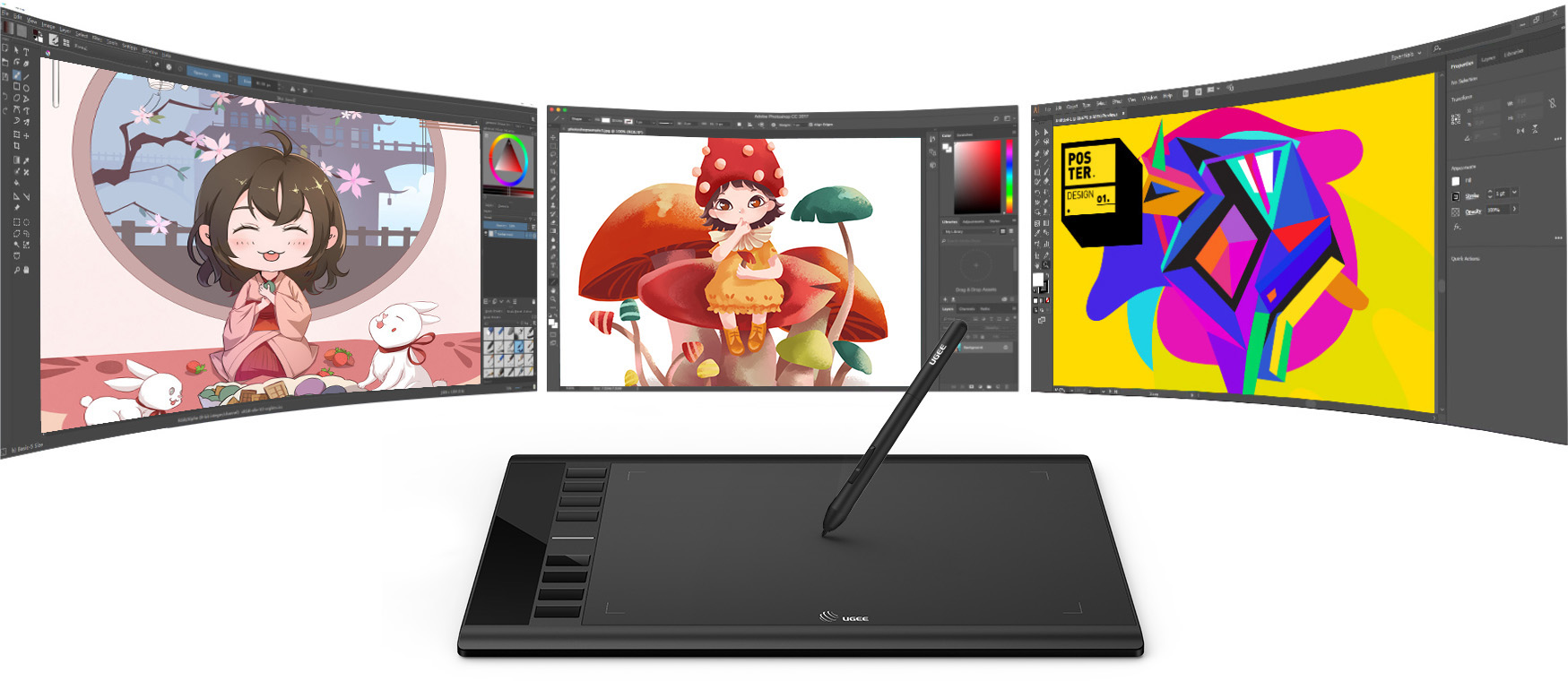
The included stylus is battery-free, requires no charging, and supports 8192 levels of pressure sensitivity and up to 60 degrees of tilt action. This means the pen never runs out of power, and you can create natural line variations by pressing harder or softer, just like a traditional pencil or brush. The tilt function lets you shade and sketch at angles, mimicking real-world drawing tools.
On the left side of the tablet, you'll find 8 customizable express keys. These keys can be programmed for various software applications to streamline workflow, for example, you can assign one key to undo, another to zoom, and a third to switch brush sizes. The keys are positioned so you can press them without lifting your hand from the pen, keeping your flow uninterrupted.
The tablet connects to your computer via a Micro USB cable and includes USB-C adapters for broader compatibility. This flexible connection system means you can use the M708 with older laptops, modern ultrabooks, and even some mobile devices that support USB-C.
Customizing your tablet for drawing
Once the driver is installed, you can tailor the M708 to your exact drawing style. The Ugee driver software gives you full control over the work area, pen pressure, and express key functions.
Adjusting the work area mapping
Launch the driver software from your system tray (Windows) or menu bar (Mac). To adjust the work area, launch the driver software, tap the tablet's active area with your stylus, and then adjust your computer's display and the tablet's work areas. This allows you to map the entire tablet surface to your full monitor, or use only a portion of the tablet for more precise control. If you have a multi-monitor setup, you can choose which display the tablet maps to.
Configuring pen pressure sensitivity
In the driver settings, look for the "Pen" or "Pressure" tab. Here you can adjust the pressure curve, the relationship between how hard you press and the resulting line thickness. A softer curve means light presses produce thicker lines, while a steeper curve requires more force for the same result. Adjust the curve until you find the response that feels most natural for your hand.
Programming the express keys
Open the "Buttons" or "Keys" section in the driver software. Click on each of the 8 express keys and assign a function from the dropdown menu, or input custom keystrokes. For example, in Photoshop you might set Key 1 to "Ctrl+Z" (undo), Key 2 to "B" (brush tool), and Key 3 to "E" (eraser). You can create different profiles for different software applications, tailoring the shortcut keys to match the specific needs of each program. Save your profiles with descriptive names like "Photoshop" or "Illustrator" so you can switch instantly.
Using the tablet with creative software
The Ugee M708 works with virtually all professional creative applications, and its pressure sensitivity and tilt features enhance your work across each one. Here's how to get the most out of the tablet in popular programs.
Photoshop
In Photoshop, open the Brush Settings panel (F5) and ensure "Shape Dynamics" and "Transfer" are enabled. Under "Shape Dynamics," set "Size Jitter" to "Pen Pressure", this makes brush size respond to how hard you press. Under "Transfer," set "Opacity Jitter" to "Pen Pressure" for natural shading. The M708's 8192 pressure levels give you fine control over these dynamics, allowing for smooth transitions between thin and thick strokes.
Illustrator
Illustrator's Blob Brush and Paintbrush tools support pressure sensitivity. Select the Paintbrush tool, then double-click it in the toolbar to open its options. Check "Fidelity" and "Smoothing" to your preference, then enable "Pressure" under "Size." This lets you create variable-width strokes that mimic hand-drawn ink lines. The tilt function also works in Illustrator for calligraphic effects, set "Tilt" under "Angle" in the brush options.
SketchBook
SketchBook automatically detects the M708's pressure sensitivity. If you're not seeing pressure response, go to the Brush Properties panel and ensure "Pressure" is enabled for both "Size" and "Opacity." SketchBook also supports the tablet's tilt for realistic pencil shading, select a pencil brush and tilt the pen to see the lead angle change on screen.
In all software, take advantage of the tablet settings program to adjust pen sensitivity, shortcut keys, and other preferences to suit the specific requirements of each program. Remember that practice is key, and it may take some time to fully adapt to the tablet's features in each software program.
Troubleshooting common Ugee M708 problems
Even reliable tablets occasionally have issues. Here are solutions to the three most common problems M708 users encounter.
Tablet not detected
If your computer doesn't recognize the M708, first ensure that the USB cable is securely connected to both the tablet and your computer. Make sure you have installed the necessary drivers for your operating system, and restart your computer after installation. If the tablet still isn't detected, uninstall the driver, disconnect the tablet, restart, then reinstall the driver and reconnect the tablet.
Pressure sensitivity not working
Check your software settings to ensure that pen pressure sensitivity is enabled. Additionally, try adjusting the sensitivity settings within the tablet settings program. Restarting your computer and recalibrating the tablet may also help resolve this issue.
Cursor misaligned
If the cursor doesn't follow your pen correctly, open the tablet settings program and find the orientation settings. Follow the instructions to align the tablet's mapping with your screen. Make sure to calibrate the tablet if necessary, this is usually a "Calibrate" button in the driver that asks you to tap specific points on the tablet surface. If the misalignment persists, try changing the display resolution or scaling in your operating system, as high-DPI displays can sometimes confuse tablet mapping.
If you encounter any persistent issues or have unique inquiries, don't hesitate to seek assistance from Ugee or the specific software support teams. The official Ugee website provides troubleshooting guides, FAQs, and customer support contact information. Remember, each individual's experience with the Ugee M708 graphics tablet may vary, but the solutions above resolve the vast majority of problems.
\nRelated reading: How To Use The Samsung Galaxy S6, How To Use Samsung Portable SSD T7, and How To Use Onn USB-C To HDMI Adapter.