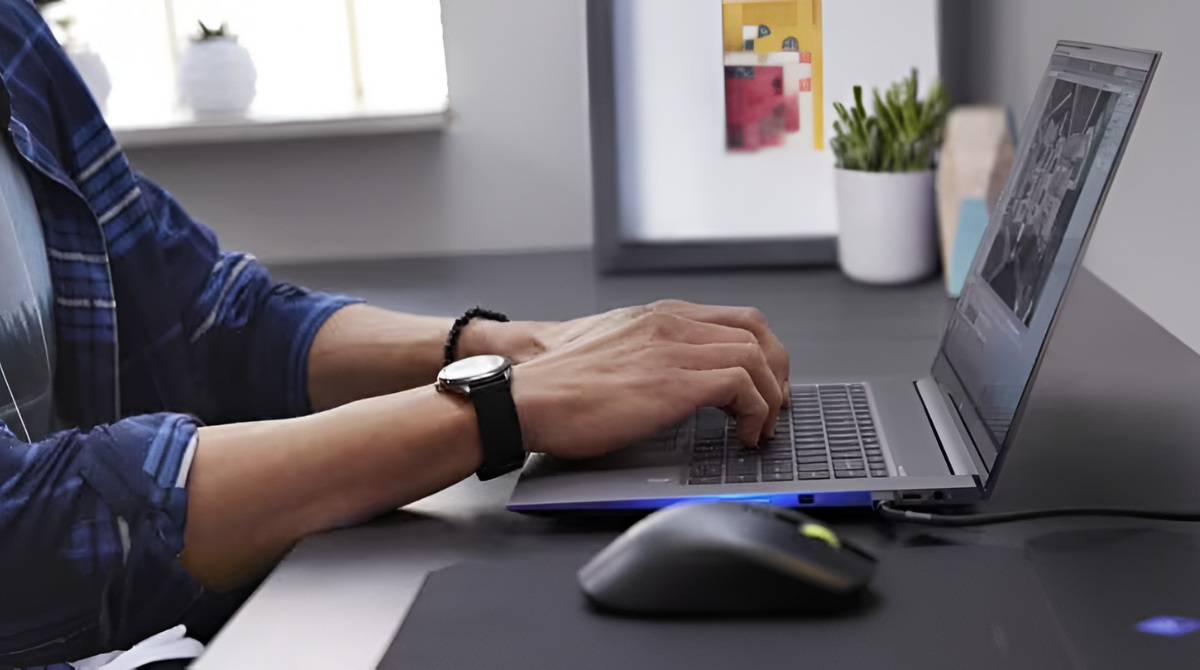
The fastest way to zoom in on hp laptop is to hold down the Ctrl key and press the + (plus) key; each press increases the zoom level, and Ctrl + - (minus) zooms back out. This works in almost every application and web browser, and you can instantly return to the default view with Ctrl + 0 (zero). If you need to zoom in on hp laptop quickly without touching the keyboard, an external mouse gives you an even faster option.
How to zoom in on HP laptop with keyboard shortcuts
Keyboard shortcuts are the most universal method because they work across browsers, office apps, PDF readers, and most other software. To zoom in, press Ctrl + +; to zoom out, press Ctrl + -. Each press changes the zoom by a fixed step, so you can tap repeatedly to reach the exact level you want. To reset the page or document back to 100%, press Ctrl + 0.
If you are using an external mouse, you can zoom in or out in many applications and web browsers by holding the Ctrl key and rolling the scroll wheel up (to zoom in) or down (to zoom out). This is often the most natural method because it lets you adjust the zoom continuously with a single hand while the other hand stays on the keyboard. The shortcut works in Chrome, Firefox, Edge, Word, Excel, and most other programs that support zooming.
Use the touchpad to pinch-to-zoom on your HP laptop
HP laptop touchpads support the same pinch gesture you use on a smartphone. Place two fingers slightly apart on the touchpad, then move them together to zoom out or apart to zoom in. This is especially handy when reading a document or viewing a photo, because the zoom follows your fingers and feels intuitive.
If pinch-to-zoom is not working, you can enable or disable the touchpad's pinch-to-zoom feature by searching for "Touchpad settings" in Windows, then navigating to "Scroll & zoom" or "Gestures" and selecting or deselecting the "Pinch to zoom" option. The exact wording varies slightly depending on your Windows version and touchpad driver, but the setting is always under the touchpad section of Windows Settings. Once enabled, the gesture works in browsers, file explorers, and most modern apps.
Change display scaling to make everything larger
If you want to zoom in on everything on your screen at once, not just one app or window, adjust the display scaling. This changes the size of text, icons, and all interface elements system-wide. Go to Start > Settings > System > Display, and adjust the "Scale" setting under the "Scale & layout" section. Windows will show you a percentage, and it is generally recommended to use the scaling percentage marked as "(Recommended)" for optimal clarity and compatibility.
Custom display scaling percentages can be set between 100% and 500%, but some older applications may not be compatible and might not scale correctly. In that case, text or buttons could appear blurry or cut off.
Magnify part of the screen with the Windows Magnifier tool
When you need to zoom in on a specific area, like a small footnote, a graph, or a tiny button, the Windows Magnifier tool gives you precise control. To magnify the entire screen using the Windows Magnifier, press the Windows logo key + + (plus sign). The Magnifier window will appear, and once it is active, continue pressing the Windows logo key + + to zoom in further, or Windows logo key + - to zoom out. To turn off the Windows Magnifier, press the Windows logo key + Esc.
Magnifier settings, including the default zoom level, zoom increments, and different view modes (Full Screen, Docked, Lens), can be adjusted in Start > Settings > Accessibility > Magnifier. In Full Screen mode, the entire screen is enlarged; in Docked mode, a magnified strip appears at the top of the screen while the rest stays normal; in Lens mode, a circular magnifier follows your mouse cursor. You can switch between these modes using the "Views" menu inside the Magnifier window. This tool is ideal for reading dense text or inspecting fine details, and it works regardless of which application you are using.
Adjust zoom settings in your internet browser
Browsers have their own zoom controls that work independently from the system-level settings, so you can zoom in on a webpage without changing the size of your desktop icons or other apps. In Google Chrome, press Ctrl + + or Ctrl + - to zoom in or out, or click the three-dot menu, then use the zoom controls in the menu bar. In Microsoft Edge, press Ctrl + + or Ctrl + -, or click the three-dot menu, select "Settings," then "Appearance," and change the "Page zoom" option.
All three browsers also let you reset the zoom to 100% with Ctrl + 0. If you frequently need larger text on every website, you can set a default zoom level in the browser settings so that every page opens at your preferred size. This is separate from the display scaling on your HP laptop, so you can keep your desktop at the recommended scale while making web pages larger or smaller as needed.
Related reading: How To Zoom Out On Dell Laptop, How To Zoom Out On A Computer, and How To Take A Screenshot On An HP ZBook Workstation.