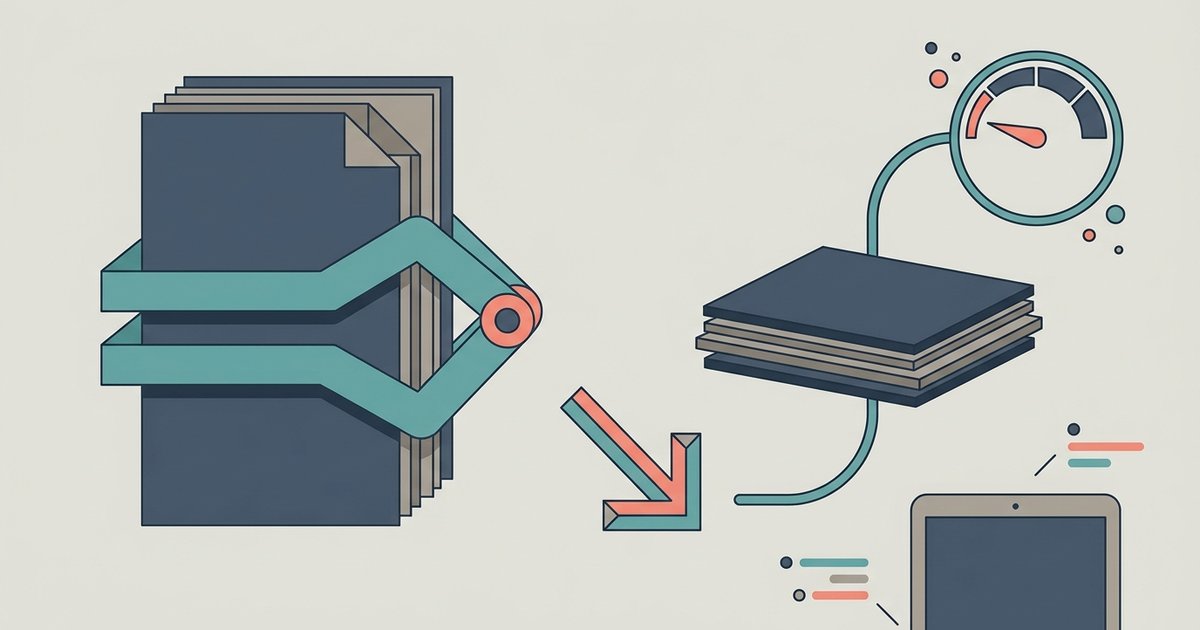
To compress a PDF, run it through a compressor that resamples the images inside it, then check the result before you send it. Almost all of the size in a large PDF comes from scanned pages and photos, so that is where the savings are. A PDF that is mostly text is already small and will barely shrink, whatever tool you use.
The trick to keeping quality is choosing the right strength for where the file is going. A PDF for email can be squeezed hard. One that is going to a printer should be left close to its original.
Compress a PDF with PDFBEAR
The recommended option is PDFBEAR's Compress PDF tool, which works in any browser and offers three strength levels, so you can trade size against quality instead of accepting a single setting. The site states that it is free and that it takes files up to 50 MB for free users. Here is how to compress a PDF online with PDFBEAR:
- Open the Compress PDF page and drop your file onto the upload area, or click to browse for it.
- Under Compression level, choose one of the three options: Extreme compression (less quality, high compression), Recommended compression (good quality, good compression) or Less compression (high quality, less compression).
- Click Compress PDF.
- The result page shows the file size before and after. Download the compressed file.
Start with Recommended. If the file is still too large, go back to the original and try Extreme. If a scanned page looks soft, try Less. Always compress from the original rather than compressing an already compressed copy, because each round loses a little more detail.
Some things to expect. On a text-only file, the tool may report that the PDF is already optimized, and the output can even end up a few kilobytes larger, which is normal. Free downloads can wait briefly in a queue. Guests have a small daily allowance of free files, and a free account removes that cap. In testing, PDFs downloaded on the free tier carried a small "PDFBEAR.COM - Free Ver." line in the bottom corner of the page, and the pricing page lists removing it as a Premium feature. The site also says password-protected PDFs have to be unlocked before they can be compressed.
Why some PDFs shrink and others do not
A PDF is a container. Text and vector drawings take up very little space. Images take up a lot, especially a page scanned at print resolution or a phone photo dropped into a document without resizing. Compression tools mostly work by:
- Lowering the resolution of images to something suited to a screen.
- Re-encoding images with stronger JPEG compression.
- Removing duplicate or unused data the file has been carrying.
- Including only the characters of each font that are actually used.
That explains the pattern people notice. A 30-page contract exported from Word may be a few hundred kilobytes and cannot go much lower. A 10-page scan of the same contract might be many megabytes and can drop dramatically, because every page is a large image.
Keeping the quality you need
Compression that is too aggressive shows up in predictable places. Scanned text goes fuzzy around the edges, fine print becomes hard to read, photos show blocky artifacts, and thin lines in diagrams break up. A few habits prevent most of it:
- Compress last. Do all your merging, editing and signing first, then compress the final file once.
- Keep the original. Save the compressed version under a new name until you have checked it.
- Check the worst page. Open the compressed file and zoom in on the page with the smallest print or the most detailed image.
- Match the destination. A file for reading on screen can take much more compression than one for printing or archiving.
- Remove pages you do not need. Deleting blank or irrelevant pages is a lossless way to cut size.
Compress a PDF on a Mac with Preview
Preview can compress a PDF without uploading it anywhere. Apple's steps:
- Open the PDF in Preview.
- Choose File then Export.
- In the Quartz Filter menu, choose Reduce File Size, as Apple's guide to reducing a PDF's size in Preview describes.
- Save under a new name, so you keep the original.
Apple warns that the compressed PDF may be of lower quality than the original. In practice the Reduce File Size filter has no strength setting and can be heavy-handed with scanned pages, so check the result closely. Apple's guide also lists export options to optimize images for screen and save images as JPEG, which give you a little more control.
Make a smaller PDF from Word or Office
If you are creating the PDF yourself from Word, you can make it small from the start. On Windows, when you save as PDF, open the options and choose Minimize size (publishing online) instead of the standard setting. It is also worth compressing large pictures inside the document before exporting, since a single uncompressed photo can outweigh everything else in it.
The same logic applies to scans. If you are scanning paper yourself, a lower resolution and grayscale instead of color make a far smaller file, as long as the text is still sharp.
Compressing on a phone
Browser-based compressors, including PDFBEAR's, work in a phone browser. You upload from the Files app on iPhone or from your file manager on Android, then save the result back. For scanned documents, the scanner built into Google Drive on Android and the Files and Notes apps on iPhone produce PDFs of reasonable size to begin with, which is often enough to avoid compressing at all.
Other options
Adobe Acrobat has its own compression tools, including a reduce file size option and more detailed optimization settings in the paid version. If a PDF refuses to shrink or behaves strangely in every tool, the file may be damaged, and repairing it or re-exporting it from the source document usually works better than compressing it again.
Common compression problems
- The file barely shrank. It is probably mostly text and vector graphics, which are already stored efficiently. Removing unneeded pages is the only real saving left.
- Scanned text looks blurry. The compression level was too strong for a scan. Go back to the original and use a lighter setting.
- The tool rejects the file. It is often password-protected. Unlock it first if you own it or have the password, compress it, then protect it again.
- It is still over the limit. Split the PDF into two parts, or rescan the paper at a lower resolution or in grayscale.
- Links stopped working. Good compressors keep hyperlinks and bookmarks. If yours did not, try a different level or tool and keep the original for reference.
Uploading sensitive files
PDFBEAR states that files are sent over HTTPS, deleted automatically after a period and not reviewed by staff. That suits most everyday documents. Bank statements, medical records and anything under a confidentiality agreement are better compressed with Preview or at export time in Word, since those never leave your computer.
If you are fighting an upload limit right now, try the Recommended level first and check one detailed page before you send. If it is still too big, split the document into two files instead of pushing compression to the point where the pages become hard to read.
\nRelated reading: How to Edit a PDF Without Adobe Acrobat, PDF Guide: Convert, Compress, Merge, Sign and Edit PDFs, and How to Convert a PDF to Word (and Word to PDF).